Taxes & Structures
US LLC: Wyoming, New Mexico, Delaware, Florida or Texas?
Björn Skamrahl · 12 August 2026 · 12 min read
Wyoming, New Mexico, Delaware, Florida or Texas? Anyone forming a US LLC quickly runs into the question of the “best” state. But low fees, privacy and the absence of state income tax only tell part of the story. What matters is what job the company is meant to do — and where its business actually takes place.
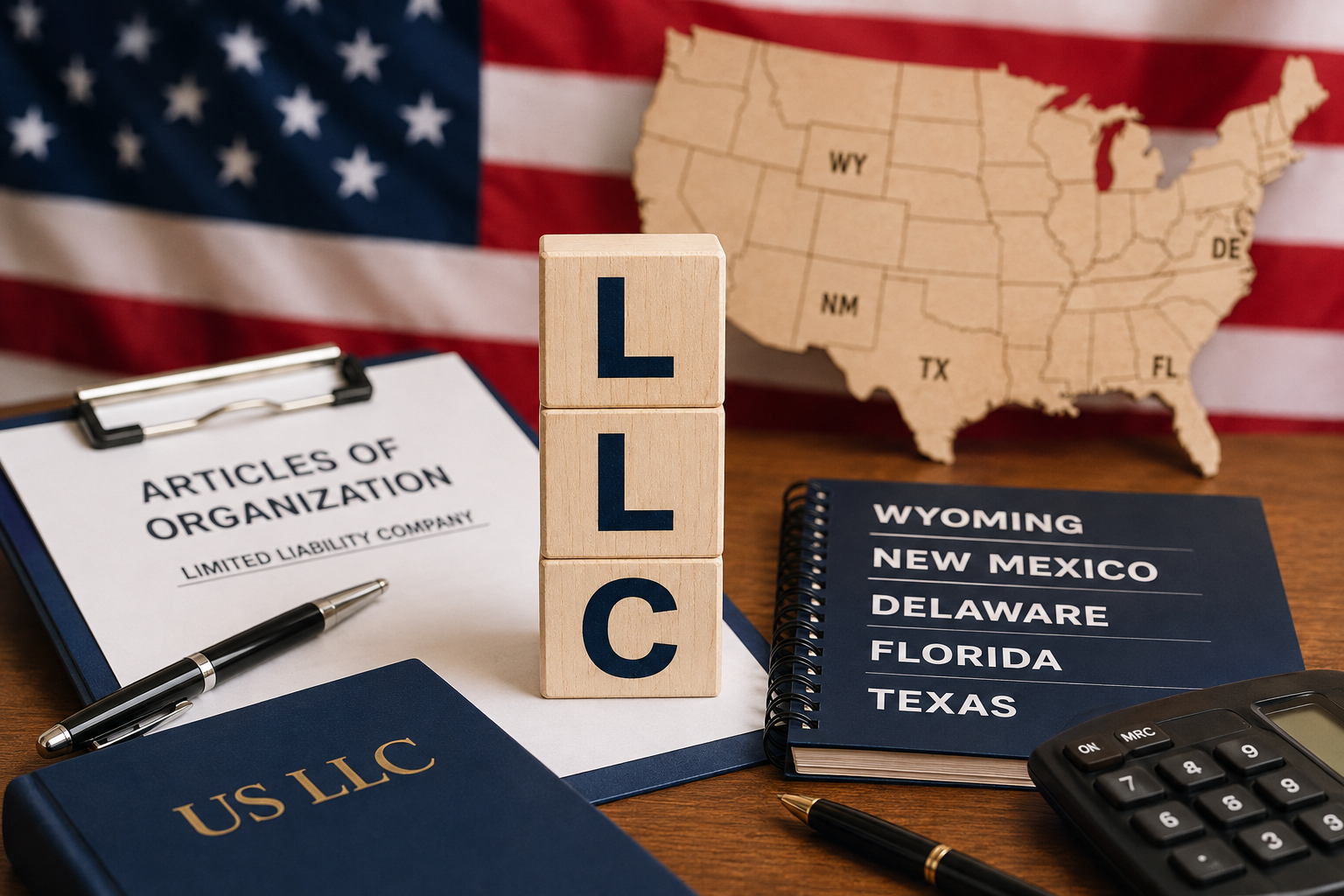
„Which state is the best one for an LLC?“
Hardly any question about US entities is asked more often.
And hardly any can be answered sensibly before another one has been settled: what is this company actually meant to do?
An LLC comes into existence under the law of a specific US state.
Wyoming, New Mexico, Delaware, Florida and Texas therefore do not simply offer the same product with five different addresses.
Formation formalities, ongoing obligations, public register data, state taxes and fees can differ.
Even so, the importance of the state of formation is regularly overestimated.
Because the choice of state answers neither the federal tax treatment of the LLC alone nor the taxation of its owner.
„The state determines which LLC is formed. It does not, on its own, determine how its owner is taxed.“
1. Three levels that must not be confused
With a US LLC, three levels must be considered separately.
- First: the corporate law of the state under whose law the LLC was formed.
- Second: the tax treatment at the federal level.
- Third: the place where the company actually carries on business and thereby may create further tax or corporate-law connecting factors.
Precisely with internationally deployed LLCs, these levels are frequently blurred together.
For federal income tax purposes, a single-member LLC is generally treated as a disregarded entity, provided no other tax classification has been elected.
That is a federal tax classification.
It does not arise because the LLC was formed in Wyoming, New Mexico or Delaware.
How a US LLC fundamentally functions from a tax perspective, why “disregarded” does not mean “tax-free”, and what role residence, source of income, USTB/ECI, place of management and Form 5472 each play, we have already covered at length in The US LLC: A powerful tool — but not a tax strategy.
That is where the next question begins:
„Once the LLC is settled on as the instrument — in which state should it come into existence?“
2. Privacy is not anonymity
One of the most common reasons for choosing a particular state is so-called privacy.
In international LLC marketing, a term regularly crops up that promises more than it delivers legally:
„anonymous LLC“
No separate corporate- or tax-law category of that name exists.
Instead, different information layers must be kept distinct.
- Public register: Which names and addresses can any third party find via the state's business database?
- Registered agent / company records: What information must be held by the registered agent or within the company?
- Tax authorities: What information do the IRS and, where applicable, state tax authorities receive?
- Banks and financial institutions: What details are required under KYC and compliance procedures?
- Federal reporting obligations: What additional information obligations exist under federal law?
These levels are not identical.
An owner may therefore not appear in a public state register and nonetheless be fully identified vis-à-vis the bank, the IRS or other relevant authorities.
„Not publicly visible is not the same thing as anonymous.“
3. Wyoming: the pragmatic classic
Wyoming is among the states most frequently named for internationally deployed LLCs.
There are genuinely sound reasons for that.
Formation is comparatively lean. The Articles of Organization contain in particular details of the LLC together with the registered office and registered agent. There is no general requirement to disclose the beneficial owner publicly in the Articles of Organization purely on account of their ownership position.
At the same time, Wyoming is by no means free of ongoing obligations.
An LLC must file an annual report.
The annual license tax is, in principle, a minimum of USD 60, or 0.0002 of the value of the assets located and employed in Wyoming, whichever is higher.
For an internationally deployed LLC without significant assets in Wyoming, the state-level burden can therefore remain relatively light.
That explains part of its popularity.
It does not, however, support the claim that a Wyoming LLC is automatically “tax-free” or its owner “anonymous”.
A registered agent remains required.
Federal tax obligations remain in place.
Banks carry out their own KYC checks.
And the owner's taxation is not determined by the word “Wyoming” appearing on the certificate of formation.
„Wyoming can be a lean corporate home. It does not substitute for an international tax strategy.“
4. New Mexico: lean, but no hiding place
New Mexico frequently appears in the international LLC market alongside Wyoming.
There are understandable reasons for that too.
A domestic LLC can be formed with comparatively low state fees, and corporate-law administration can be kept lean.
Precisely out of this, however, a persistent marketing narrative has emerged: the “anonymous New Mexico LLC”.
Here too, the label is misleading.
Which information appears publicly depends on the documents actually filed and the specific structure. Certain owner information need not appear publicly in the same way as in some other states purely on account of the shareholding.
That does not, however, mean that the owner is unknown to the relevant authorities or financial institutions.
There is a second point to add:
New Mexico naturally has its own tax system.
Anyone actually carrying on business there, or otherwise creating relevant tax connecting factors, can be confronted with state-level filing and tax obligations.
The gross receipts tax can also become relevant depending on the activity.
„New Mexico can be lean from a corporate-law perspective. It does not follow that carrying on business in New Mexico is tax-neutral.“
5. Delaware: reputation is no substitute for analysis
Delaware is probably the most internationally recognised US corporate domicile.
Numerous large corporations and complex ownership structures make use of the state.
There are good reasons for that.
Delaware has a highly developed body of corporate law, decades of case law, and, in the Court of Chancery, a specialised institution for corporate-law disputes.
Precisely from this, however, a problematic inference tends to follow:
„If Delaware is good for large US corporations, Delaware must also be the best choice for my LLC.“
That does not follow.
A Delaware LLC generally need not file a classic annual report as a corporation would, but it is subject to an annual state tax of USD 300.
For complex ownership arrangements, institutional investors, venture-capital structures, or cases where Delaware's developed body of corporate law is genuinely needed, the state can offer considerable advantages.
For a simple single-member LLC belonging to an internationally active consultant or online entrepreneur, by contrast, those advantages need have no practical significance.
That is no disadvantage of Delaware's.
It merely means that reputation is no substitute for analysing the specific case at hand.
„The best-known corporate domicile is not automatically the most suitable one.“
6. Florida: when the LLC ends up where its owner lives
Florida illustrates particularly well why the debate over the state of formation should not be conducted in isolation.
The state has no classic personal state individual income tax.
That makes Florida attractive as a place of residence for entrepreneurs and high-net-worth individuals.
A Florida LLC is nonetheless not free of state-level obligations.
It must file an annual report every year.
The standard fee is USD 138.75.
If the annual report is filed after 1 May, a late fee of USD 400 is added.
Florida is even more interesting in connection with privacy.
At formation, the state expressly notes that members need not be listed in the Articles of Organization purely on account of being a member.
At the same time, numerous pieces of information filed with Sunbiz become publicly accessible.
Depending on the specific structure and subsequent filings, details of responsible persons in particular can become publicly visible.
Privacy is therefore not a state that is fixed once at formation and remains unchanged thereafter.
„What does not appear publicly at formation can become visible through later filings.“
But Florida leads to an even more important question.
What happens if someone owns a Wyoming LLC but actually lives in Florida, maintains an office there, employs staff and runs the business from there?
In that case, the Wyoming formation alone cannot prevent Florida from becoming relevant under corporate and tax law.
That brings us to one of the most important points in this piece.
7. Texas: no personal income tax does not mean no state tax
Texas is likewise among the states without a classic personal state individual income tax.
From this, too, an overly simple conclusion is sometimes drawn: if Texas levies no personal income tax, the corporate state level must also be practically meaningless.
That is not correct.
With the franchise tax, Texas has its own system for businesses.
For the 2026 franchise tax report, the no-tax-due threshold stands at USD 2.65 million in annualized total revenue.
Where annualized total revenue is at or below this threshold, no franchise tax is generally due.
For reports due on or after 1 January 2024, a no-tax-due report is no longer required in these cases either. A Public Information Report (PIR) or Ownership Information Report (OIR) may nevertheless still need to be filed.
Other reporting obligations can still exist.
Above the relevant threshold, franchise tax obligations can arise depending on the activity, the basis of calculation and other requirements.
For our comparison, the specific calculation formula matters less than the underlying insight:
„No personal state income tax does not mean: no state-level taxes and no state-level compliance.“
Texas also differs from the classic privacy jurisdictions with regard to public registers.
At formation, details of the initial governing persons are required.
Texas thus stands as an example of a state that can be highly attractive as an actual business and personal domicile, without thereby offering the leanest register structure for a purely international LLC.
8. Foreign qualification: the actual place of business cannot be formed away
An LLC initially has the corporate-law home of its state of formation.
That is not, however, where the analysis ends.
If it actually carries on business in another state, registration as a foreign LLC may become necessary there.
The word “foreign” occasionally causes misunderstandings.
From Florida's perspective, a Wyoming LLC is already a foreign LLC.
It need not originate from another country for that.
What matters is that it was formed under the law of another US state.
Which activities trigger a foreign qualification requirement is governed by the law of the relevant state and must be examined in the specific case.
The principle nonetheless matters.
Anyone who forms an LLC in Wyoming but actually operates a business in Florida or Texas cannot avoid the corporate and tax rules there simply because the certificate of formation originates from Wyoming.
„You can choose the state of formation. You cannot register away the actual place of business.“
That also strips some of the significance from the frequently asked question
„Where is the LLC cheapest?“
of part of its meaning.
A company that subsequently has to register in a second state can generate additional fees, registered-agent costs and compliance obligations.
The supposedly cheapest formation can thereby turn into the more complicated structure.
9. Five states — five different profiles
Ongoing state-level obligation
Wyoming
Annual report
New Mexico
comparatively lean corporate-law administration
Delaware
no classic LLC annual report
Florida
Annual report
Texas
state/tax reporting depends on the situation
Typical ongoing feature
Wyoming
annual license tax from USD 60
New Mexico
low corporate-law base costs
Delaware
USD 300 annual state tax
Florida
USD 138.75 annual report; USD 400 late fee after missed deadline
Texas
franchise tax system; 2026 no-tax-due threshold USD 2.65m
Public-record privacy
Wyoming
comparatively high
New Mexico
comparatively high
Delaware
comparatively high
Florida
more strongly shaped by public filings
Texas
details of governing persons are relevant
Typical use / strength
Wyoming
lean international LLC structure
New Mexico
low corporate-law administration
Delaware
more complex / institutional structures
Florida
actual US personal and business domicile
Texas
actual US business domicile
Typical fallacy
Wyoming
“tax-free”
New Mexico
“anonymous”
Delaware
“always the best choice”
Florida
forming in Wyoming eliminates Florida nexus
Texas
no personal income tax means no state tax
This overview is deliberately not a ranking.
It merely shows why the same question can lead to different answers depending on the structure.
10. Cost is rarely the decisive criterion
Comparisons of LLC states are frequently dominated by figures such as 50 dollars, 60 dollars, 138.75 dollars or 300 dollars.
For serious international structuring, these differences are usually not the central problem.
Whether a company generates a few hundred dollars more or less in state fees each year is often secondary next to incorrect tax classification, unnecessary foreign qualification, or an unsuitable corporate structure.
That applies particularly to entrepreneurs and high-net-worth individuals.
„A company should not be chosen over a USD 200 difference in fees when the wrong structure can cost thousands in tax.“
Cost belongs in the decision.
It should not dominate it.
11. BOI under the Final Rule: less reporting does not mean anonymity
The rules on reporting beneficial owners under the Corporate Transparency Act have undergone substantial changes within a short period.
A timeline is therefore important.
As early as March 2025, FinCEN, through an interim final rule, removed US-formed entities and US persons from the BOI reporting requirements.
Domestic U.S. entities were thus already exempt from this reporting obligation.
On 11 August 2026, FinCEN then published the final rule permanently entrenching this realignment. It takes effect on 14 August 2026.
As things stand today, the following should be noted:
„The final rule does not newly create the BOI exemption for domestic LLCs. That exemption already applies under the 2025 interim final rule. The final rule published on 11 August 2026 permanently entrenches this realignment and takes effect on 14 August 2026.“
And even more important:
This development does not make an LLC “anonymous”.
The BOI report to FinCEN was only one information layer.
Tax identification and reporting obligations continue to exist independently of it.
Banks carry out KYC checks.
Registered agents remain subject to their respective statutory obligations.
State filings can contain publicly accessible information.
„The end of a reporting obligation is not the end of identifiability.“
12. Which state is the right one, then?
That brings us back to the starting question.
Wyoming? New Mexico? Delaware? Florida? Texas?
The serious answer does not begin with a name.
It begins with questions.
- Where does the owner live?
- Where is the business actually run from?
- Where are the employees based?
- Where are the offices or other operational facilities located?
- Where are the customers based?
- What activity does the company carry out?
- Are there other members or investors?
- Is institutional capital planned?
- What information should legitimately not appear publicly in a state register?
- What tax treatment arises at the federal, state and home-state level?
- Is foreign qualification in another state going to be required in any event?
Only once these questions have been answered does the choice of state of formation make sense.
For a location-independent single-member LLC owned by an entrepreneur living outside the United States, Wyoming or New Mexico can be an obvious option.
For more complex ownership or investor structures, Delaware can have qualities that are genuinely needed.
Anyone who, by contrast, actually lives in Florida or Texas and runs an operating business there should examine whether forming directly in the actual state of business does not produce the simpler structure; the consequences of taking up residence in the United States overall are addressed in The USA as your centre of life: One country, 50 tax systems — and a decision with consequences.
None of these statements is a blanket recommendation.
They merely show why the answer depends on the actual facts.
13. The state's name is no substitute for a structure
The popularity of certain LLC states has spawned an industry of its own.
Wyoming is marketed with privacy.
New Mexico with anonymity.
Delaware with prestige.
Florida and Texas with the absence of personal state income tax.
Each of these claims contains a real kernel of truth.
They become problematic only once a single feature is turned into a complete structuring decision.
An LLC is not a Wyoming address.
It is not a Delaware reputation.
And it does not become tax-free simply because its owner does not appear in any public state register.
It is a company within a federal system.
Its state of formation is one component of that structure — not a substitute for it.
The structure first. Then the state.
Wyoming can be right.
New Mexico can be right.
Delaware can be right.
And anyone who actually lives in Florida or Texas and runs their business there can have good reasons to form the entity there.
The right decision does not depend on which state scores the most ticks in an online comparison.
It depends on what job the company is meant to do and which legal, tax and economic connecting factors actually exist.
„The wrong decision does not begin with the wrong state.“
„It begins with the idea that the name of a state could substitute for an international structure.“
Sources & further data
- IRS — Limited Liability Company (LLC) — Basic overview of the LLC and its federal tax classification options
- IRS — Single Member Limited Liability Companies — Treatment of the single-member LLC as a disregarded entity and alternative classification elections
- IRS — About Form 5472 — Reporting obligations for foreign-owned U.S. disregarded entities and foreign-controlled companies
- FinCEN — Beneficial Ownership Information — Official information page on reporting obligations under the Corporate Transparency Act
- FinCEN — Interim Final Rule (March 2025) — Interim final rule removing US-formed entities and US persons from the BOI reporting requirements
- FinCEN — Final Rule of 11 August 2026 — Final rule on BOI reporting; published 11 August 2026, effective 14 August 2026
- Wyoming Secretary of State — Business Center — Official information on formation, registered agent and the business database in Wyoming
- Wyoming Limited Liability Company Act (W.S. Title 17, Chapter 29) — Statutory basis of the Wyoming LLC, including requirements for the Articles of Organization and registered agent
- Wyoming Secretary of State — Annual Report — Annual report obligation and calculation of the annual license tax (minimum USD 60 or 0.0002 of Wyoming-located assets)
- Wyoming Secretary of State — Fee Schedule — Official fee overview for formation and ongoing filings
- New Mexico Secretary of State — Corporations & Business Services — Formation of a domestic LLC, filings and the public business database in New Mexico
- New Mexico Taxation and Revenue Department — State-level tax registration and filing obligations
- New Mexico Taxation and Revenue — Pass-Through Entities — Treatment and filing obligations of pass-through entities in New Mexico
- New Mexico Taxation and Revenue — Gross Receipts Tax — Scope of the gross receipts tax for business activity in New Mexico
- Delaware Division of Corporations — Official information on forming and administering Delaware entities
- Delaware Division of Corporations — How to Form a New Business Entity — Formal requirements for forming a Delaware LLC
- Delaware Division of Corporations — Annual Tax / LLC Tax FAQ — Annual state tax of USD 300 for LLCs and the distinction from the corporate annual report
- Delaware Limited Liability Company Act (Title 6, Chapter 18) — Statutory basis of the Delaware LLC
- Florida Division of Corporations (Sunbiz) — Official business database and filing portal of the State of Florida
- Sunbiz — Florida LLC Filing Instructions — Requirements for the Articles of Organization, including the note on listing members
- Sunbiz — Annual Report Information — Annual reporting obligation, the 1 May deadline and the USD 400 late fee
- Sunbiz — Fees — Fee overview including the USD 138.75 annual report fee for LLCs
- Texas Secretary of State — Business & Nonprofit Forms — Certificate of Formation (Form 205) for a Texas LLC, including details of governing persons
- Texas Comptroller — Franchise Tax — Structure of the Texas franchise tax and filing obligations
- Texas Comptroller — Franchise Tax Frequently Asked Questions — No-tax-due threshold and the removal of the no-tax-due report since the changes taking effect in 2024
More perspectives
Taxes & Structures
The US LLC: A powerful tool – but not a tax strategy
Easy to set up, flexible, internationally established – and still not a tax strategy. Why a US LLC can be an excellent tool, where its tax limits lie, and why artificial substance often does more harm than good.
Read articleEconomy & Jurisdictions
The USA as a Life Base: One Country, 50 Tax Systems – and a Decision with Consequences
The United States can hardly be viewed, for tax purposes, like an ordinary country of residence. Federal law, 50 states, worldwide-income taxation and different routes into tax residency make the location decision complex. Anyone who wants to live there should therefore answer two questions separately: do I want to become part of the American system – and if so, where?
Read articleTaxes & Structures
Steuerwohnsitz & Betriebsstätte: Der Guide für Auswanderer
Steuerwohnsitz und Betriebsstätte sind zwei verschiedene Zahnräder – und sie müssen ineinandergreifen. Wer nur eine Firma im Ausland gründet oder sich irgendwo anmeldet, hat noch keine Struktur. Ein praxisnaher Guide zu §§ 8, 9, 10 und 12 AO, DBA-Ansässigkeit und dem Tax Residency Certificate.
Read article