
Taxes & Structures
The US LLC: A powerful tool – but not a tax strategy
Cheap, flexible, internationally usable and excellently suited to many business models: the US LLC is one of the most important building blocks of international corporate structures. That does not make it tax-free — far from it. What matters is who owns it, where the work is actually performed, where management is exercised, where the owner is tax resident, and what function the LLC actually fulfils.
Klaus J. P.-Kilfitt · 28 July 2026 · 13 min read
The US LLC is, to my mind, one of the most interesting corporate vehicles for internationally active entrepreneurs. It is comparatively easy to set up, flexible in its design, limits liability, is internationally established, and suits numerous digital and cross-border business models. Properly structured, an LLC held by a non-US citizen can enjoy a genuinely favourable tax starting position in the United States.
Hardly any other vehicle is marketed with so many half-truths at once. „0% tax.“ „No bookkeeping.“ „No tax return.“ „Just set up in Wyoming and you're done.“ On the other side, structures are recommended in which entrepreneurs are told to rent offices, install external representatives, or create supposed „substance“ even though none of it is economically needed.
I consider both extremes wrong. A US LLC is neither a tax loophole nor a tax problem. It is something far more useful: an extraordinarily flexible corporate vehicle. But an LLC is precisely not a tax strategy. It is a tool within an overall structure.
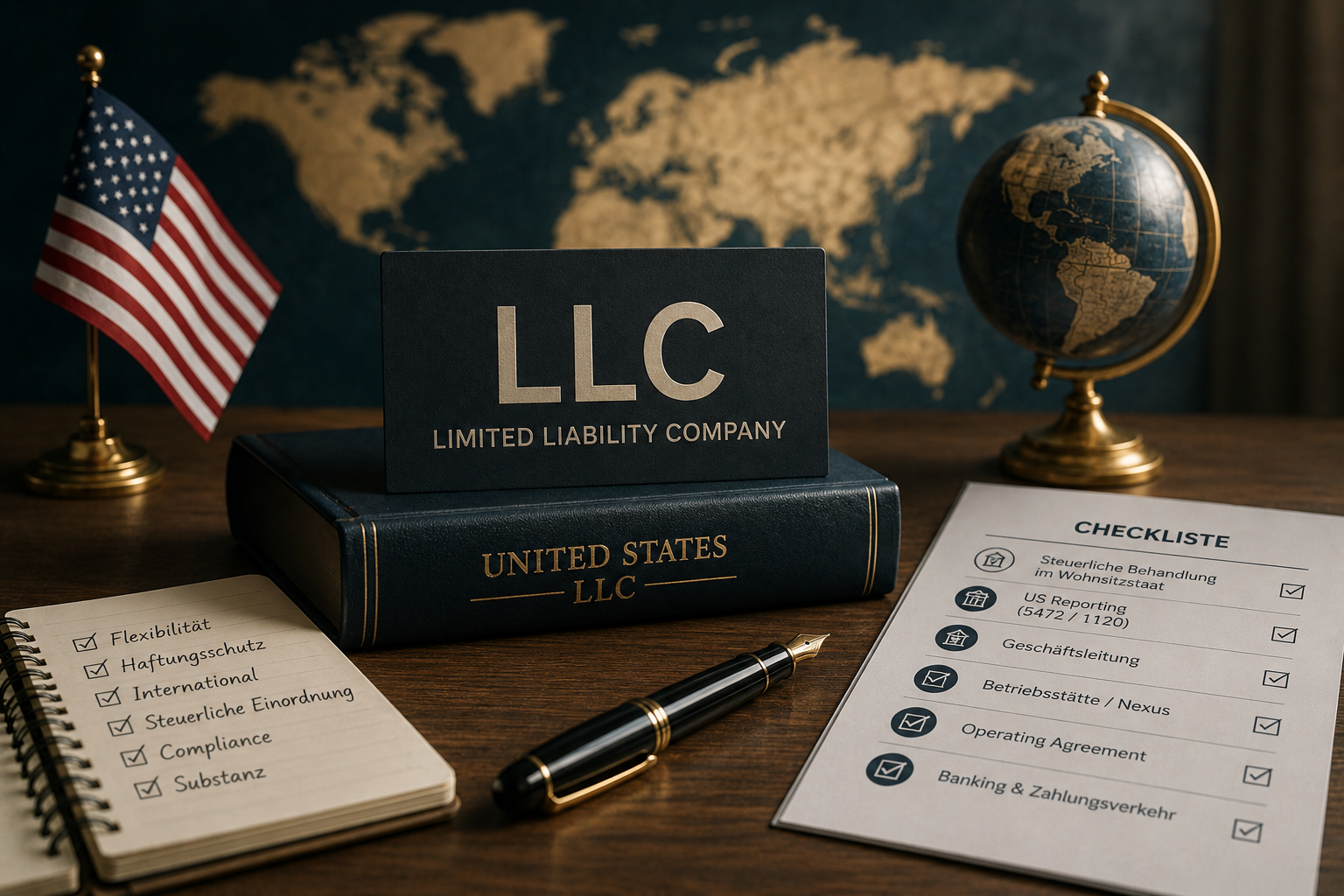
What an LLC actually is
LLC stands for Limited Liability Company. It is a company formed under the law of a US state, with its own corporate structure and, in principle, limited liability for its members.
But this is precisely where a problem with international assessments begins: the corporate-law existence of an LLC and its tax treatment are two separate questions. And its tax treatment in the United States need not correspond to its tax treatment in Germany, Paraguay or any other state.
One company. Several legal systems. Possibly several different tax classifications.
Single-member LLC: what „disregarded“ actually means
If an LLC has only one owner, it can in principle be treated as a so-called disregarded entity for US federal income tax purposes, provided no alternative tax classification has been elected.
The term regularly leads to misunderstandings. „Disregarded“ does not mean: the LLC does not exist. And it certainly does not mean: the LLC is tax-free.
What it means, first of all, is that the company is not treated, for certain US federal income tax purposes, as a taxable subject separate from its owner. This is precisely what brings the person behind the company into focus.
The LLC is not a tax rate. It is a legal form. Why percentages mean almost nothing without a taxable subject, a tax base and source rules is something I set out in more detail in the article 0%, 1% or 5%? Why tax rates are barely comparable across borders.
Why the result can still be zero dollars of US income tax
The appeal of a foreign-owned single-member LLC arises, among other things, from the interplay between its tax classification and America's source rules. For personal services, what generally determines the source of income is where the service is actually performed.
Take an entrepreneur living in Paraguay. He owns an LLC in Wyoming. His clients are in Germany and the United States. Contracts are concluded through the LLC. Invoices are issued by the LLC. The money goes into a US business account. The entrepreneur himself, however, sits in Asunción and performs his personal work from there.
- The company is American.
- One client is American.
- The bank account is held in the United States.
These circumstances alone do not automatically turn a personal service performed outside the United States into US-source personal service income. This is precisely where the LLC can become genuinely interesting.
But that only answers half of the tax equation
If the United States does not tax a particular item of income, that does not automatically mean nobody taxes it. That sounds trivial. Yet in international LLC discussions, precisely this point is skipped astonishingly often.
- Where does the owner live?
- Where is he tax resident?
- Where does he actually work?
- How does his state of residence classify the LLC?
- How does that state treat the profit?
- Where is management located?
- Might a permanent establishment exist?
- What other tax connecting factors exist?
The US tax neutrality of an LLC is not automatically the tax neutrality of its owner. How residence, actual activity and the concept of a permanent establishment interact is addressed in the article Tax residence & permanent establishment: the guide for expats.
A structure is not tax-free merely because one state involved does not tax it
Take Paraguay again. Under its source rules, the United States may conclude that no US-source personal service income arises for personal services performed outside the United States.
Paraguay can look at the very same facts from its own perspective and conclude: the personal activity was carried out in Paraguay. That raises the question there of income of Paraguayan source – as described in detail in the article Paraguay: territorial taxation does not automatically mean 0% tax.
Both statements can be true at the same time. There is no contradiction. Two states are assessing the same economic facts according to their respective tax rules.
This is precisely why international tax planning must never stop at the question „What does the US require?“ How competing taxing rights of two states are then resolved is shown in the article Double tax treaties: who is actually entitled to tax what?.
When the US can still reach in after all
Naturally, not every foreign-owned LLC automatically sits outside the reach of US taxation. What matters in particular can be actual activity within the United States. Concepts such as US Trade or Business (USTB) and Effectively Connected Income (ECI) then become relevant.
Genuine operative activity in the United States can change the tax analysis. The same applies, depending on the facts, to employees, offices, certain agents, real estate, inventory, and other economic connecting factors.
That is also why the commonly heard claim „no US clients = no US tax“ is far too simplistic. For personal services, the client's location is precisely not automatically the source of the income. What matters is the specific facts – the same logic applies from the perspective of the state of residence, as the example Philippines: when foreign income really has to come from abroad shows.
There is no such thing as floating income
This brings us to a debate that has run for years within the international tax community. Can entrepreneurial income, in a sense, become „stateless“ if an entrepreneur has no fixed centre of life for tax purposes and his company likewise has no clearly attributable place of management?
This question is genuinely disputed among practitioners. My own position is clear: I do not find the notion of „floating income“ permanently suspended in tax nowhere convincing. This is expressly my reasoned legal opinion, not an undisputed legal position.
I find the opposing view more persuasive, not least because recent German administrative guidance on the concept of a permanent establishment and on management-based permanent establishments speaks clearly against the idea that profits could float between states without any tax attribution – set out in the article Permanent establishment after emigration: why the new BMF circular matters more for expats than it sounds.
There is also the extended limited tax liability under section 2 of the German Foreign Tax Act (AStG), which, following an emigration to a low-tax jurisdiction, can under certain conditions preserve German connecting factors. This too shows that the German legislator does not proceed on the assumption that income disappears for tax purposes through mobility.
Business activity takes place. Business decisions are made. Companies are run. To my mind, the decisive question is therefore not whether a place of management exists. It is: where is it located?
Member-managed: who actually runs the LLC?
In a member-managed single-member LLC, the company is, in principle, run by its owner. He makes the day-to-day business decisions. He concludes contracts. He determines corporate policy. He controls the accounts. He decides on clients, pricing, investment and business development.
To my mind, this makes the member's actual activity of central importance in determining the place of management. Someone who lives permanently in Paraguay and actually runs his member-managed LLC from Paraguay is in a completely different position from someone who merely registers an American company while continuing to make all management decisions from Germany.
The state where the LLC is registered does not automatically answer the question of actual management.
Management does not migrate by magic – it migrates through actual direction
That said, one should not fall into the opposite oversimplification. Not every trip taken by the owner automatically shifts the place of management. What remains decisive is the actual state of affairs:
- Where are the material, day-to-day business decisions made?
- Who makes them?
- What governance structure has actually been put in place?
- Have functions been effectively delegated?
- And does the lived reality match the corporate-law structure?
In a classic member-managed single-member LLC that is actually run exclusively by its owner, there is, to my mind, much to be said for looking for the actual place of management wherever that owner exercises his business management decisions.
Why I often consider artificial offices and external representatives superfluous
In parts of the international advisory industry, a remarkable conclusion is drawn from this. An office is recommended. An external managing director. A permanent representative. An artificial operative presence. Sometimes several of these at once. All so that „substance“ appears somewhere, as visibly as possible.
I consider such constructions wrong when they are not economically needed at all. Substance should arise wherever it economically belongs – not wherever some LLC guru orders it up for decoration.
More substance is not automatically better
An entrepreneur who actually lives in Paraguay and runs his business from there does not necessarily need an artificial American office just to make his LLC look „more American“. Quite the opposite.
Genuine operative activity in the United States can create additional tax connecting factors of its own. The same applies, depending on the arrangement, to employees, agents or other functions. Anyone who wants to avoid a US tax nexus should not go and create one for purely decorative reasons.
A structure does not become more professional by having more components. It becomes more professional when each component fulfils a comprehensible function.
The special case of the perpetual traveller
For entrepreneurs who are genuinely not tied to any one place, the question of management and tax attribution is naturally more complicated. Anyone who moves permanently between states, has no stable centre of life, and runs their business in the process, generates different lines to be drawn.
That is a tax-interesting case. But it is not the normal case this article is concerned with. Most established entrepreneurs do not want to spend their lives commuting between Bangkok, Medellín and Dubai with a laptop and carry-on luggage. They have families. Children. Assets. Real estate. Businesses. And, quite often, simply a wish for a home.
„International freedom does not mean being forbidden from having a centre of life. It means being able to choose it yourself.“
For entrepreneurs with a fixed centre of life, the structure is often clearer
If an entrepreneur's actual centre of life is, say, in Paraguay, and he runs his LLC permanently from there, the economic reality can be described far more clearly. He lives there. He works there. He makes his business decisions there. Within this structure, his LLC fulfils a defined international function.
That does not automatically mean every tax question is resolved. But it does mean that the structure does not depend on making a place of management artificially disappear.
Germany can view the same LLC entirely differently from the United States
This brings us to one of the most important peculiarities of international LLC structures: the United States' tax classification does not automatically apply worldwide. A single-member LLC may be a disregarded entity for US federal income tax purposes. Germany is under no obligation to adopt that classification.
From the German perspective, what is examined, by way of a so-called entity classification comparison (Rechtstypenvergleich), is which German corporate type the specific foreign entity most closely resembles. As a result, the same LLC can be classified differently for tax purposes in two states.
Depending on the classification and the facts, additional German special rules for foreign companies may become relevant. This does not mean that every LLC falls under CFC taxation (Hinzurechnungsbesteuerung) – when these rules can even apply is addressed in the article CFC taxation & CFC rules: why letterbox companies fail with German residence.
Corporation or partnership?
For an entrepreneur with a German connection, this question can have significant consequences. Depending on its specific corporate-law design, an LLC may, under the German entity classification comparison, correspond more closely to a corporation or more closely to a partnership.
It is therefore not enough to simply state: „It's an LLC.“ What matters is: exactly how is this particular LLC structured?
The operating agreement is not a formality
With many bargain-basement formations, the operating agreement is treated like a file that gets downloaded automatically once registration succeeds and is then never opened again. For an internationally structured LLC, that is not enough.
The operating agreement governs central corporate-law questions. Among the matters that can be relevant:
- management authority
- authority to represent the company
- members' rights
- profit distribution
- transferability of interests
- continuation of the company
- dissolution rules
- decision-making mechanisms
- and other features that can gain significance within a foreign entity classification comparison
But the operating agreement does not decide alone
Here too, a simple formula would be tempting: „If we draft the operating agreement accordingly, the LLC is a partnership in Germany.“ That is not how the entity classification comparison works.
What matters is the overall picture of the corporate-law features. These include, in particular, the statutory rules of the relevant US state, the specific design of the operating agreement, and the further actual and legal characteristics of the company.
The operating agreement is therefore an important design instrument. But not a tax magic wand.
Tax classification belongs at the beginning
This is precisely why I consider it wrong to first form some off-the-shelf LLC and only afterwards think about how it will actually be treated in the owner's state of residence. The order needs to be reversed.
- First: What is the LLC supposed to achieve within the overall structure?
- Then: How does it need to be structured under corporate law to achieve that? What tax classification is to be expected in the relevant state of residence? What reporting obligations arise? What nexus risks exist?
- And only then: In which state, and with what specific design, is it formed?
A $400 LLC is not yet international tax planning
A US LLC can today be formed through numerous providers for a few hundred dollars. There is nothing objectionable about that in itself. Simply registering a company is genuinely not a particularly complicated process.
But registering a $400 LLC online is not international tax planning. No more than buying a wrench makes someone a mechanical engineer. Registration is often the easiest part of the entire structure.
The cheap formation can end up being the most expensive option
Problems arise when, after formation, it turns out that:
- The operating agreement does not fit.
- The entity classification comparison was never considered.
- The tax treatment in the state of residence was never examined.
- US reporting was never set up.
- The company was formed in the wrong state.
- The specific activity creates unexpected tax connecting factors.
- Banking and payment processing do not fit the business model.
- Or required filings simply were not made for years.
At that point, structuring does not begin. Repair begins.
Form 5472 and Form 1120: this is where casualness ends for me
A particularly important point is American reporting obligations. A foreign-owned US disregarded entity can in particular be required to file Form 5472 together with a pro-forma Form 1120, where the statutory conditions are met.
These obligations are not an optional recommendation. And here I expressly take a different stance from parts of the international expat and LLC scene. I do not regard the argument „no one actually checks this in practice“ or „no claimant, no judge“ as a serious foundation for a corporate structure.
An obligation remains an obligation, even if no one asks about it
Anyone using a US company must meet its statutory compliance obligations. The fact that an authority may not actively demand a filing does not turn a statutory reporting duty into a voluntary exercise.
For Form 5472, US law provides for a penalty of, in principle, US$25,000 per affected form for a filing that is late or incomplete; where the failure continues after an IRS notice, further amounts can be added. That is a completely unnecessary risk. An international structure should not rely on an authority hopefully never noticing an error.
Professional LLC support does not end after formation
A professionally set-up foreign-owned LLC must therefore include, from the outset, a robust compliance process. Depending on the specific structure, this can in particular include:
- corporate-law design
- operating agreement
- EIN
- registered agent
- state filings
- review of US tax classification
- Form 5472
- pro-forma Form 1120
- any further federal or state filings as applicable
- review of possible FBAR or other reporting obligations, where relevant in the individual case
- banking and KYC
- ongoing record-keeping
- as well as coordination with the tax treatment in the owner's state of residence
The US reporting side in particular belongs in the hands of a US tax professional with the appropriate qualifications and experience with foreign-owned LLCs.
Why old LLC guides can be especially dangerous
International corporate structures do not change completely every month. But reporting obligations very much can change. A good example is American beneficial-ownership reporting under the Corporate Transparency Act.
Until quite recently, numerous US companies had to assume they would need to file corresponding BOI reports with FinCEN. The legal position was subsequently changed substantially: under the currently applicable FinCEN rule, this general BOI reporting obligation no longer applies to domestic entities formed in the United States.
An LLC guide can therefore remain correct in its basic principles while already being out of date on a specific compliance question. Tax and corporate structures require ongoing maintenance.
What a US LLC can be excellently suited for
After all these warnings, one thing should not be lost: I continue to regard the US LLC as a genuinely powerful instrument. It can be particularly interesting for:
- internationally active service businesses
- digital business models
- consulting businesses
- software and online businesses
- certain e-commerce structures
- international contracting and invoicing structures
- certain holding and investment arrangements
- and further cross-border business models
Whether it actually fits always depends on the specific facts.
What it is not automatically suited for
An LLC is not a one-size-fits-all solution. Regulated activities can have different requirements. Business models with substantial operative US presence must be assessed differently. Real estate can trigger special tax consequences.
E-commerce can raise state-nexus and sales-tax questions that must be considered entirely separately from federal income tax. Employees change structures. And some states of residence tax an LLC so unfavourably or make its treatment so complex that a different corporate form may make more sense. The right tool depends on the task.
A good LLC structure does not begin in Wyoming
It begins with the person behind it.
- Where does he live?
- Where is he tax resident?
- Where does he work?
- What does he sell?
- Where are his clients based?
- Where are his employees located?
- Where is the business actually run from?
- What assets does it hold?
- Which profits are to be distributed?
- Which are to be reinvested?
- Which states have tax connecting factors?
- And what function is the LLC supposed to serve within this overall structure?
Only once these questions have been answered does the following question make sense: which LLC do we actually need?
Conclusion: a tool, not a legend
The US LLC is neither a tax loophole nor a miracle cure. It is something far more useful: an extraordinarily flexible corporate vehicle. Used correctly, it can be an excellent building block of an international structure. Used incorrectly, it remains an American company standing in front of an economic reality that, for tax purposes, may well be playing out somewhere else entirely.
A member-managed LLC has an actual place of management. Personal services are performed somewhere. The owner has a tax situation. Other states can classify the LLC differently from the United States. And even a structure that is tax-favourable in the United States carries reporting and compliance obligations.
That is why professional LLC structuring does not begin with the cheapest formation form. It begins with the question of what task this tool is supposed to fulfil within the overall structure.
The decisive question is not: „Is a US LLC tax-free?“ It is: „Does a US LLC fit what is actually happening economically?“ If the answer to that is yes, then to my mind it remains one of the strongest tools of international corporate structuring.
„The US LLC is not a tax strategy. It is a tool within a tax and corporate strategy.“
This article serves general orientation purposes and does not constitute tax or legal advice. Where indicated, it contains the author's personal legal opinion on matters that are subject to professional debate. What is always decisive is the individual case, the currently applicable rules of the states involved, and current administrative practice.
Sources & further data
- IRS — Single Member Limited Liability Companies — Official guidance on the treatment of a single-member LLC as a disregarded entity and on alternative classification elections
- IRS — About Form 5472 — Information on the reporting obligation for foreign-owned US disregarded entities, on the pro-forma Form 1120, and on the penalty provisions
- IRS — Instructions for Form 5472 — Filing requirements, deadlines, record-keeping obligations, and the amount and continuation of penalties
- IRS — Source of Income: Personal Services — US source rules for personal services and the significance of the place where the service is actually performed
- IRS — Effectively Connected Income (ECI) / U.S. Trade or Business — Conditions under which income is treated as effectively connected with a US trade or business
- FinCEN — Beneficial Ownership Information Reporting — Current status of BOI reporting obligations under the Corporate Transparency Act, including the exemption for domestic entities
- German Federal Ministry of Finance — BMF circular on the tax classification of foreign entities — Principles of the entity classification comparison and its application to US companies such as the LLC
- Fiscal Code (Abgabenordnung) § 10 AO (gesetze-im-internet.de) — Definition of the place of management as the centre of top-level business direction
- Foreign Tax Act (Außensteuergesetz) § 2 AStG (gesetze-im-internet.de) — Extended limited tax liability following emigration to a low-tax jurisdiction
More perspectives
Taxes & Structures
Paraguay: Territorial Taxation Doesn't Automatically Mean 0% Tax
Residencia, cédula, RUC, foreign clients – and supposedly no tax. Paraguayan tax law doesn't work that simply. Why the territorial principle is really a question of source, and why that is precisely what makes Paraguay a genuinely interesting location.
Read articleTaxes & Structures
0 %, 1 % oder 5 %? Warum Steuersätze international nur bedingt vergleichbar sind
0 %, 1 %, 5 % – drei Zahlen, die aussehen wie eine Rangliste. Tatsächlich messen sie nicht dasselbe: den Umfang eines Besteuerungsrechts, einen Sondersteuersatz auf eine eigene Bemessungsgrundlage und das Ergebnis eines mehrstufigen Systems; weswegen der Prozentsatz selbst nur sehr bedingt vergleichbar ist.
Read articleTaxes & Structures
Steuerwohnsitz & Betriebsstätte: Der Guide für Auswanderer
Steuerwohnsitz und Betriebsstätte sind zwei verschiedene Zahnräder – und sie müssen ineinandergreifen. Wer nur eine Firma im Ausland gründet oder sich irgendwo anmeldet, hat noch keine Struktur. Ein praxisnaher Guide zu §§ 8, 9, 10 und 12 AO, DBA-Ansässigkeit und dem Tax Residency Certificate.
Read article