
Economy & Jurisdictions
Emigrating for Freedom – and Then Moving to California?
Why choosing your US state is far more than a tax question – and why Florida and Texas can be the more consistent choice for freedom-minded emigrants
Klaus J. P.-Kilfitt · 24 August 2026 · 12 min read
Anyone leaving Germany or the European Union because regulation, state paternalism and the growing political claim on areas of their life have gone too far should apply the same criteria when choosing their new home base.
Moving to California or New York may seem tempting for a number of reasons – politically, it can mean the very same statist claim you were actually trying to escape.
This article compares the US states from a freedom-oriented perspective: What does more regulation cost you day to day? How does the state's appetite for control actually feel in practice? And why can Florida and Texas – despite all their limitations – be the more consistent choice for freedom-minded emigrants?
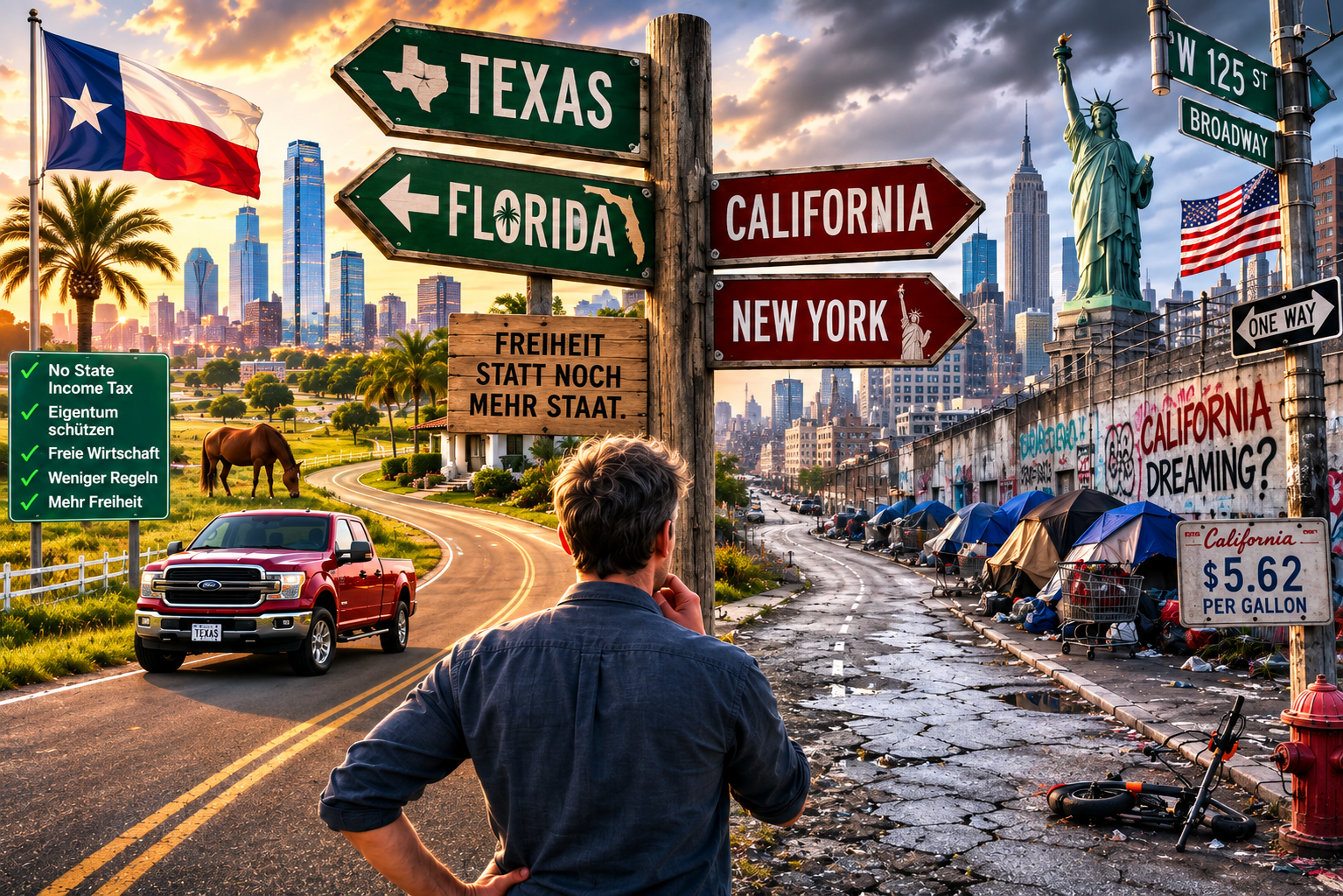
Anyone leaving Germany or the European Union because taxes are too high can simply compare tables.
Income tax. Wealth tax. Inheritance tax. Capital gains tax.
That is comparatively straightforward.
Choosing a location becomes harder for people who leave for a different reason: because they feel the state is reaching ever deeper into areas of their life that are, in truth, none of its business.
How they speak. How they heat their homes. What they drive. How they build. What their children learn at school. Which opinion is socially desirable. Which statement is still considered acceptable. Which economic decision the next regulation will restrict.
Anyone emigrating for that reason is not simply looking for a lower tax rate. They are looking for more freedom.
And anyone who, of all places, moves to the United States for that purpose should avoid one mistake:
treating America as a single location.
Because it would be a remarkable form of emigration to leave Europe over rising regulation, political paternalism and social re-education – only to discover, at the new home base, that the move could have been spared entirely.
To avoid any misunderstanding: freedom is neither left nor right and belongs to no party colour. This article is therefore not a plea for any particular party.
The authoritarian state does not become more liberal simply by hanging a national flag rather than a rainbow flag outside the government building.
Conservative governments, too, can regulate, prohibit, surveil and interfere in the private lives of their citizens. The political right has historically held no monopoly whatsoever on freedom – the proverbial Prussian authoritarian state is practically its emblem.
On the other side stands a socialist conception of the state that wants to collectivise ever larger parts of economic and social decision-making – necessarily diametrically opposed to the claim of individual freedom.
The decisive question is, at bottom, remarkably simple:
„How much decision-making does a state leave to the individual – and how much does it claim for itself?“
From a freedom-oriented perspective, then, this comparison of American states quite consistently produces no simple left–right result.
The Cato Freedom in the 50 States index examines more than 230 policy variables covering economic and personal freedom. In the current edition, Florida ranks second overall. New York lands, once again, in last place. California is likewise near the bottom. At the same time, the index shows that economic and personal freedom by no means automatically go hand in hand.
Texas is a good example of that.
More on that later.
America Is 50 Political Experiments
In the previous article on the US as a home base, we already pointed out that, from a tax perspective, the United States is not really a single location decision.
The same is true in socio-political terms.
The First Amendment applies in California just as it does in Florida. And the American constitutional understanding of free speech differs fundamentally from the European model.
Anyone moving from Germany to California is therefore not moving to "Germany with palm trees".
But within this shared constitutional framework, the states have developed in remarkably different directions.
Taxes, business regulation, building law, property rights, school policy, gun law, drug policy, occupational licensing and numerous other areas are decided largely at state level.
Federalism thereby makes America something that Europe is increasingly losing:
a competition between different political models.
The same applies to choosing the seat of a US LLC.
And people can vote on it with their feet.
California: How Much Regulation Can a Dream Withstand?
Hardly any state lends itself better to this examination than California.
Because hardly any other location has better starting conditions.
Sun. Beach. Hollywood. Silicon Valley. Venture capital. Technology. Agriculture. Entertainment. Some of the most valuable companies in the world.
Millions of people dreamed for generations of living there.
California was not just a state.
It was a promise.
That is precisely why what has quietly happened there over recent years is so remarkable.
Between 2010 and 2024, according to the Public Policy Institute of California, nearly ten million people moved from California to other US states. Over the same period, just over seven million people moved from other states into California.
According to the PPIC, California has been losing net residents to other US states every year since 2001.
That does not mean California will be deserted tomorrow.
Even if one might sometimes get the impression that a considerable share of L.A.'s population is still frying burgers there because Hollywood hasn't made the decisive call yet.
But jokes aside.
What is remarkable is not that people are leaving California.
People move all the time.
What is remarkable is the duration and direction of this trend, in a state that, geographically, climatically, economically and culturally, has conditions much of the world might envy.
The PPIC identifies enormous housing costs as a particularly important factor. Since 2015 alone, California has recorded a net loss of nearly 900,000 people who cited housing costs as the main reason for their move. In surveys, 34 percent of Californians had seriously considered leaving the state because of high housing costs.
The more interesting question is therefore this:
How much political and regulatory dysfunction does it take for people to leave a location that offers them almost everything?
When Regulation Becomes a Way of Life
California stands as a prime example of a political mindset in which almost every social problem appears solvable through yet another state rule.
Each one of them may, in isolation, be somehow justifiable and perhaps even sensible.
Environmental protection.
Employee protection.
Tenant protection.
Consumer protection.
Building codes.
The problem lies in the sum total.
At some point, a location no longer consists of a single well-meaning regulation, but of thousands of them.
And at some point, the question is no longer whether a particular rule originally served a good purpose, but whether citizens and businesses still have any meaningful room to make their own decisions.
California itself has now begun reforming parts of its permitting and regulatory structures.
Perhaps that is the most striking confirmation of the problem:
when a state has to simplify its own rules again, one may at least ask whether there had previously been a few rules too many.
Freedom Sometimes Shows Itself as Plainly as at the Petrol Pump
One can discuss regulation in highly abstract terms.
But sometimes a glance at the pump is enough.
On 24 August 2026, regular gasoline in Texas cost, according to AAA, an average of around $3.62 per gallon. The American average stood at around $4.10.
In early August, California stood at around $5.66, putting it at the top of the continental United States.
Naturally, that gap is not purely down to policy.
Crude oil prices, refinery capacity, logistics and regional market conditions also play a role.
But since 1 July 2026, California alone levies 63.4 cents in state fuel tax per gallon, on top of the federal tax and the sales tax charged at the point of sale. On top of that come California's particular fuel and environmental requirements.
The current spike in US petrol prices makes these differences all the more visible: in August, the federal government even announced it would ease seasonal fuel requirements early and temporarily waive stricter standards in California and Texas, among others, in order to increase supply.
„A petrol price is not a freedom index. But it is a good illustration of the fact that political decisions eventually leave the realm of abstract debate. In the end, they show up on the bill.“
Voting with the Corporate Address
Companies, too, vote with their feet.
Or, more precisely, with their headquarters.
Between 2015 and 2024, according to the Texas Comptroller, 314 companies relocated their headquarters to Texas.
157 of them came from California.
Among them are prominent names such as Tesla, Oracle and Chevron.
California's own PPIC has examined the trend and reaches a sobering conclusion: from 2011 to 2021, California lost a net total of roughly 1,250 corporate headquarters.
California's economy is of course not disappearing overnight, but the number of departing headquarters increased over the study period, and Texas is among the dominant destinations for that outflow.
So the question is this:
Why do companies leaving one of the most economically powerful locations in the world so often choose Texas?
Taxes play a role.
Regulation plays a role.
Costs play a role.
The availability of land and labour plays a role.
And eventually something emerges from all this that is harder to measure:
an economic-policy climate.
California: Prosperity and Squalor Side by Side
There is another contrast that belongs to California's reality.
Enormous private wealth exists immediately alongside visible public squalor.
Los Angeles and San Francisco have become symbols of this.
Tent encampments and open homelessness have, for years, been part of the streetscape in parts of these cities.
Looking at these catastrophic conditions, one question forces itself upon us:
How could one of the richest, most innovative and economically most powerful locations on Earth ever reach a state in which mass homelessness became the normal appearance of entire streets?
New York: When Big Government Becomes a Political Programme
On the East Coast, New York City represents a different manifestation of the same conflict:
high taxes, heavy regulation and a pronounced statist ambition have long defined the Big Apple.
The fact that the city has been governed since 2026 by Zohran Mamdani, who explicitly describes himself as a socialist and pursues a programme that is clearly consistent with that label, is therefore less a cause than a symptom of a broader political development.
So the question is this:
If you are leaving Europe because its political development has become too collectivist and paternalistic – why would that very same political model then be attractive at your new home base?
Florida: Freedom as a Location Factor
Florida is not interesting because everything is better there.
It isn't.
The state struggles with high insurance premiums, rising property costs, infrastructure problems and the particular risks of a region regularly hit by hurricanes.
Florida, too, passes laws whose compatibility with a consistently freedom-oriented conception of the state can certainly be debated.
But the underlying architecture is remarkably different.
Florida levies no personal state income tax.
Even more interesting, however, is the combination of economic and personal freedom.
In the libertarian-designed Freedom in the 50 States index, Florida ranks second overall. The index evaluates more than 230 state and local policy variables and covers both economic and personal freedoms.
That does not objectively make Florida the second-best state in America – but it does make it one of the freest.
And people respond to this with their own location decisions.
Florida remains one of the major destinations for both domestic American migration and international immigration.
Californians, too, move to Florida on a net basis. For 2024, the PPIC recorded a net flow of around 12,645 people from California to Florida.
Taxes do not explain all of this.
But according to the PPIC, high-earning Californians in particular move disproportionately often to states with no personal income tax.
Texas: The Libertarian Litmus Test
To many, Texas seems even more interesting than Florida when it comes to personal freedom.
But is it really?
The sober answer is no, because Texas shows why "conservative" and "freedom-oriented" are not, in fact, the same thing.
Economically, Texas is highly attractive.
In the Cato index, Texas ranks near the top for economic freedom. The current edition places the state sixth for Economic Freedom.
No personal state income tax, comparatively business-friendly regulation, enormous amounts of land, a large domestic market and a pronounced entrepreneurial culture all contribute to this.
The result is visible.
Companies and people move there.
California alone lost a net total of more than 21,000 residents to Texas in 2024.
But personal freedom is, once again, something different from mere economic freedom.
Texas intervenes quite substantially in various areas of private life – more than the state's freedom-oriented self-image would suggest. Earlier editions of the Cato index actually scored Texas remarkably poorly on Personal Freedom; the authors pointed, among other things, to criminal justice, cannabis, education and gambling policy.
That is not a side issue, but an essential part of the overall picture.
A state can leave entrepreneurs largely alone while simultaneously taking a remarkably intense interest in the private lives of its citizens.
That is why Texas is no libertarian utopia.
Freedom Isn't Only About Taxes – But Taxes Are Part of It
Florida and Texas levy no personal state income tax.
California, by contrast, has a progressive income tax system. So does New York.
One might simply say:
Lower tax = more freedom.
It isn't that simple.
A functioning rule of law costs money.
Infrastructure costs money.
Courts cost money.
Police cost money.
Protecting property rights costs money.
The question, then, is not whether a state may claim anything at all.
It is this:
How much may it claim – and for what?
And above all:
Who then decides over what remains?
The citizen?
Or, once again, the state?
In this sense, taxes are indeed a matter of freedom.
Because every dollar the state decides how to spend is a dollar its owner can no longer decide how to spend.
That alone does not make a tax illegitimate.
But it should be enough to place the burden of proof where it belongs.
„It should not be the citizen who has to explain why he wants to keep his money. It should be the state that has to explain why it needs it.“
Freedom means, above all, leaving others alone.
At this point, some may find the concept of freedom demanding and uncomfortable.
Because personal freedom does not mean:
the state should ensure that everyone lives the way I consider correct.
It means pretty much the opposite.
Other people are entitled to make decisions I consider wrong, silly, tasteless or utterly insane.
As long as they do not infringe on the rights of others in doing so.
That applies to ways of life, religion, language, sexuality, gun ownership, diet, cannabis, upbringing, political views and much more.
A society does not become free by having the "right" people determine what is permitted.
It becomes free when as little as possible needs to be determined at all.
That is also why a libertarian position collides just as much with the left's supposedly "progressive" worldview as it does with the conservative ideal of the "strong state".
Both share a striking enthusiasm for state power.
They differ chiefly in what they want to use it for.
The American Dream Was Never a Tax Programme
Perhaps this is precisely where the real appeal of the United States lies.
The American Dream never promised equality of outcome.
It did not even promise success.
Its compelling idea was a different one:
the chance to try.
To build a business.
To acquire property.
To start over.
To fail.
To start over again.
To shape one's life according to one's own ideas.
And to bear the consequences of those decisions largely oneself.
That is a thoroughly libertarian idea.
Perhaps that is precisely the core of what was once called the American Dream:
„Not the guarantee of success, but the freedom to attempt it at your own risk.“
That is why Florida and – with the caveats mentioned – Texas appear so appealing today to freedom-minded emigrants.
Not because no problems exist there.
Not because the "right party" happens to govern there.
And certainly not because some politician invented freedom there.
But because parts of that American idea are still comparatively clearly recognisable there:
Personal responsibility.
Entrepreneurship.
Property.
And a fundamental distrust of a state that believes it must answer every social question itself.
Anyone Emigrating for Freedom Should Also Search for Freedom
In the first US article in this series, we separated two questions from one another.
First:
Do I want to become part of the American system?
And then:
Where in the United States do I want to live?
We can now refine the second question.
Anyone emigrating purely because of their tax burden can compare states using figures.
Anyone emigrating for freedom has to look deeper.
California can still be a good location for a tech entrepreneur.
New York can still be acceptable for someone whose business and social life take place there.
Florida can be unbearably hot, expensive or simply boring for someone else.
And Texas can, socio-politically, already be too much state for someone who is economically freedom-minded.
Freedom, after all, also means being allowed to decide for oneself which compromises to make.
But anyone leaving Germany or the European Union precisely because regulation, state paternalism and the growing political claim on ever more areas of their life have gone too far should not suddenly forget these criteria when choosing their new home base.
Otherwise, they will have crossed the border.
But possibly not left behind the political model they were actually trying to escape.
„Freedom does not begin at a national border. It begins with the decision of how much state you are willing to accept in your own life.“
Sources & further data
- Cato Institute — Freedom in the 50 States — Index of economic and personal freedom across all US states
- Public Policy Institute of California — Migration — Data and analysis on domestic migration to and from California
- AAA Gas Prices — Current average petrol prices across US states
- Texas Comptroller — Business Relocations — Data on corporate relocations to Texas from other states
- California Department of Tax and Fee Administration — Fuel Tax — Current state fuel tax and other California fuel levies
More perspectives
Economy & Jurisdictions
The USA as a Life Base: One Country, 50 Tax Systems – and a Decision with Consequences
The United States can hardly be viewed, for tax purposes, like an ordinary country of residence. Federal law, 50 states, worldwide-income taxation and different routes into tax residency make the location decision complex. Anyone who wants to live there should therefore answer two questions separately: do I want to become part of the American system – and if so, where?
Read articleTaxes & Structures
US LLC: Wyoming, New Mexico, Delaware, Florida or Texas?
Wyoming, New Mexico, Delaware, Florida or Texas? Anyone forming a US LLC quickly runs into the question of the “best” state. But low fees, privacy and the absence of state income tax only tell part of the story. What matters is what job the company is meant to do — and where its business actually takes place.
Read article