
Residency & Migration
Resolution 407/2026: Bureaucratic Nightmare or Pragmatic Clarification?
What the new regulation from the Dirección Nacional de Migraciones on proving economic solvency for Residencia Permanente actually requires.
Klaus J. P.-Kilfitt · 17 June 2026 · 7 min read
For the past few days, a storm of confusion, outrage, despair and Paraguay-is-finished eulogies has been raging in the relevant expat groups on Facebook, Telegram & Co.
Affected expats are searching for clarity and solutions, while some self-appointed emigration experts and enterprising immigration agencies are spreading half-truths about a new regulation they have evidently either not read, not understood – or are simply using as targeted fear-mongering to drum up business.
Having studied both the original text of Resolution 407/2026 of the Dirección Nacional de Migraciones (DNM) and the relevant literature on Paraguayan foreigner and residency law in depth, I genuinely cannot follow the excited hysteria this regulation has triggered.
Quite the opposite: on closer inspection, one gets the impression that a comparatively sober administrative act is once again being hyped into a catastrophe – to generate clicks, clients and consulting fees, or to badmouth Paraguay as a Plan B altogether and "redirect" prospective immigrants or compliance residents to other countries.
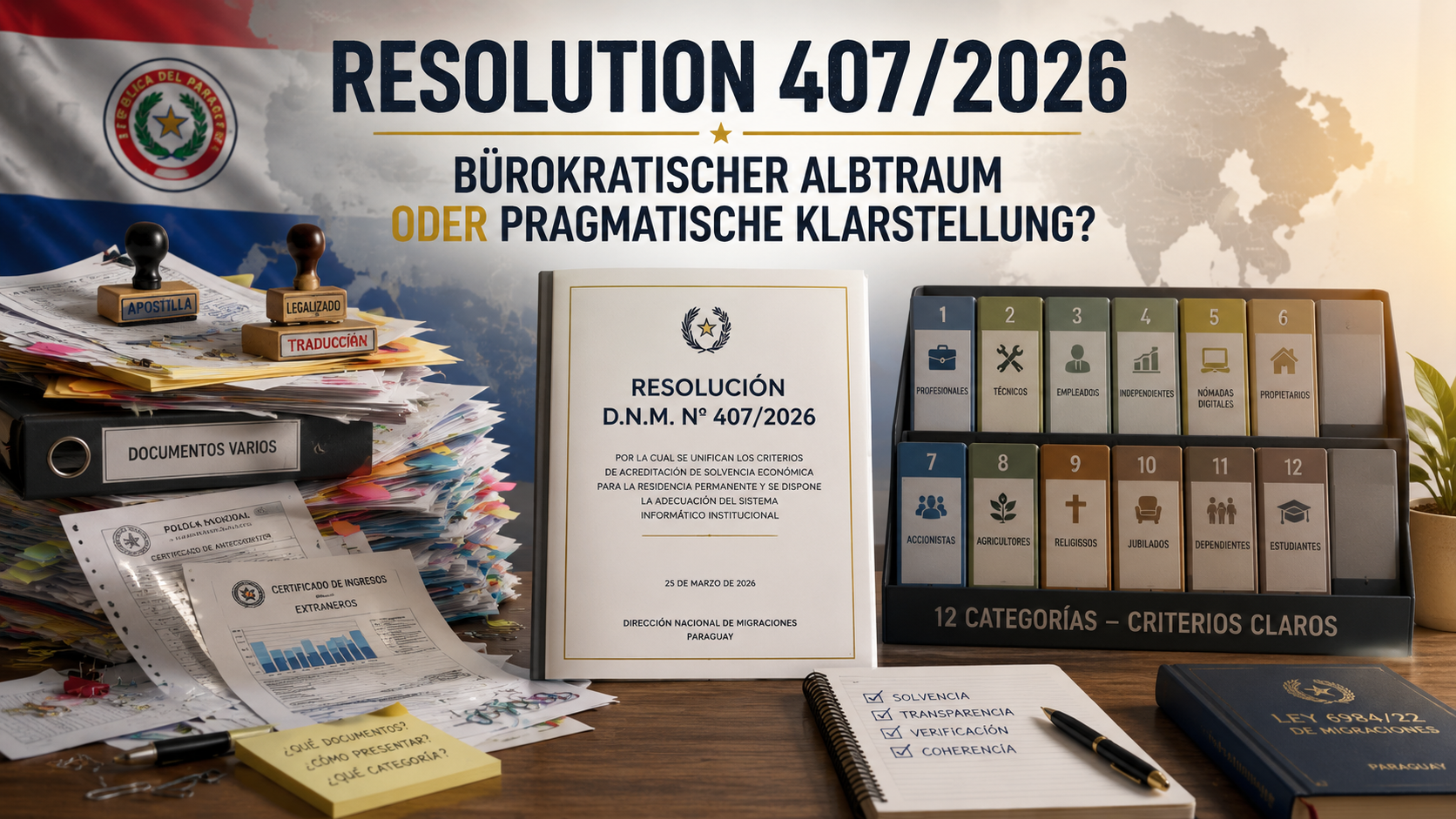
What Resolution 407 actually is – and what it isn't
Let's start with the most obvious point, which has, remarkably, been almost entirely lost in all the commotion:
Resolution 407/2026 contains no concrete numerical minimum requirements for income or wealth whatsoever.
Anyone reading the sometimes hair-raising posts claiming there are alleged wealth thresholds of X USD is welcome to ask for the source.
Spoiler: they will find nothing of the sort in the text of the resolution.
What the resolution actually regulates is comparatively sober:
It standardises the proof of "solvencia económica" within the application for Residencia Permanente and creates a structured framework for it.
This is not a new wealth hurdle.
It is, first and foremost, a standardisation and systematisation of the evidence required for economic solvency.
The decisive provisions – and why panic is misplaced
Two provisions are particularly important for understanding this: Article 3 lit. a and Article 18 of the Anexo Único.
Article 3 lit. a does, in principle, require coherence between the activity declared under the Residencia Temporal and what is subsequently demonstrated for the Permanente.
However, it expressly adds:
„sin perjuicio de las actualizaciones o variaciones debidamente acreditadas“
In essence:
Changes or updates remain possible, provided they are duly evidenced.
Had the DNM genuinely intended a rigid link to the information filled in two years earlier, this addition would hardly have been necessary.
Article 18 is even clearer.
It instructs the authority's staff to assess the applicant's actual economic situation on the basis of the documents submitted and, where appropriate, to assign him ex officio to the appropriate category.
In doing so, the resolution expressly cites principles such as "informalismo", "razonabilidad", "buena fe" and "oficiosidad".
At least on its wording, this does not point towards a rigid, rejection-oriented formalism.
Anyone constructing from this a blanket "defence law" or even a simple "No RUC – No Residency!" should therefore either double-check their sources – or explain exactly where this claim is supposed to appear in the text of the resolution.
Twelve categories instead of a one-size-fits-all solution
The structure of the Anexo Único is particularly interesting.
The resolution distinguishes twelve categories for accrediting economic solvency:
- Profesionales
- Técnicos
- Empleados
- Trabajadores independientes
- Trabajadores a distancia o nómadas digitales
- Propietarios de bienes inmuebles
- Accionistas o socios de personas jurídicas
- Agricultores o ganaderos
- Religiosos
- Jubilados o pensionados
- Dependientes
- Estudiantes
With this, the DNM is precisely not trying to force every applicant into the same economic template.
It defines different evidentiary pathways for different life and income situations.
Remote workers and digital nomads
Article 9 is particularly noteworthy.
Remote workers and digital nomads are expressly recognised as a category in their own right.
For this category, the resolution requires precisely no Paraguayan RUC, no Paraguayan IVA filings and no economic activity within the country.
What is required instead is a certificate or confirmation from the foreign company for which the person in question works. Among other things, this must show the employment relationship or activity, the income earned and the type of remuneration.
Documents originating abroad must, in line with the requirements, be legalised or apostilled and translated into Spanish.
The frequently circulated claim that Paraguay now intends to fundamentally end the classic "residency plus foreign income" model cannot, in any event, be derived from this.
Where action may genuinely be needed
The picture looks different for "trabajadores independientes".
Anyone who obtained their Residencia Temporal as a self-employed person, holds a Paraguayan RUC, but has for some time now filed nothing but zero returns, should read Article 8 very carefully.
Among other things, it requires the IVA filings of the last three months or the corresponding IRP documentation, along with a tax compliance certificate.
And it expressly states:
„debiendo demostrar el movimiento“
In other words, economic movement must be demonstrable.
This is indeed a point where existing arrangements can become problematic.
This is substantially more concrete than the many freely invented income and wealth thresholds currently doing the rounds on social media.
The real battlefield
In my view, the real disputes of the coming months will therefore not primarily revolve around alleged minimum wealth or income thresholds.
Because the resolution does not contain any concretely numbered general minimum amounts.
What will be decisive is rather this:
Under which of the twelve categories is an application for Residencia Permanente assessed – and which documents can be submitted for that specific category?
Anyone who can plausibly be classified as a remote worker, digital nomad, retiree, property owner, shareholder or under one of the other designated categories has, after reading the original text, considerably less reason for panic than some of the recent posts would suggest.
Where the resolution leaves questions open
I do, however, see a genuine blind spot when it comes to combined economic situations.
What applies, for example, to someone who receives rental income from their home country, additionally earns capital returns from a Paraguayan cooperativa, and at the same time still holds a RUC from earlier self-employed activity on which there is no longer any economic movement?
Here matters become considerably less clear-cut.
The resolution works with categories.
Real life, however, does not always comply.
And that is precisely where the first interesting questions of future administrative practice are likely to arise.
Conclusion
Resolution 407/2026 makes future administrative practice more rigorous and, at least on its wording, less arbitrary.
Supporting evidence is meant to reflect the applicant's economic reality in a traceable way, not merely tick formal boxes.
At the same time, the resolution is, in its underlying philosophy, formulated in a remarkably pragmatic manner.
The paradigm shift is, in any case, not:
"Foreign income unwelcome."
It is, rather:
„Tell us a consistent, verifiable economic story.“
Anyone who can do that is likely to sleep considerably more soundly than after reading certain social media groups.
Anyone who cannot – well, perhaps they should spend a little less time there discussing Paraguay's imminent demise.
Postscript
Later postscript to the original article of 17 June 2026.
The reactions to this article have brought to light a further weak point in the regulation.
As welcome as the creation of clear categories, together with the naming of documents suitable as proof of solvency in each case in the "Anexo Único", may be, Resolution 407 remains imprecise as to the form in which this evidence must be submitted.
The decisive sentence in Article 3 reads:
„Estar legalizada o apostillada y, cuando corresponda, traducida al idioma español.“
This wording does indeed leave room for interpretation as to which documents require translation, certification and/or apostille.
Interpreted favourably, one can conclude that the very "or" in the specific wording of the regulation already accounts for the fact that many of the documents listed under the respective categories are not public instruments but, for example, private-law documents, and are therefore in some cases not capable of being apostilled at all.
This more optimistic interpretation is also supported by the wording of Article 18 of the resolution.
There, the DNM's staff are, among other things, meant to arrive at a pragmatic overall assessment of the economic situation from the standpoint of "razonabilidad", "buena fe" and "informalismo".
At least on its wording, this argues precisely against unnecessary and unrealistic formalism.
Whether the authority actually implements the resolution in this spirit, however, will only become apparent in the administrative practice of the coming months.
Sources & further data
This article was published on 17 June 2026 and assesses the resolution from that contemporary perspective. The postscript is marked as such.
More perspectives
Strategy & Freedom
Freedom Doesn't Mean Constantly Moving On
International diversification can reduce dependencies. But maximum mobility is not automatically maximum freedom. What matters is not how many borders you cross – but whether you yourself can decide where you want to live and stay.
Read articleTaxes & Structures
Steuersysteme der Welt: Was jeder Auswanderer verstehen muss
Steuern folgen dem Wohnsitz. Das gilt in Deutschland – aber nicht überall nach denselben Regeln. Wer auswandert, ohne zu verstehen, nach welchem System das Zielland sein Einkommen besteuert, riskiert unangenehme Überraschungen: Steuernachforderungen, Doppelbesteuerung oder ein Setup, das auf dem Papier clever wirkt, in der Praxis aber nicht funktioniert.
Read articleTaxes & Structures
Territorialbesteuerung: Gesetz vs. Praxis – Die gefährliche Lücke
Territorialbesteuerung klingt einfach: Besteuert wird nur, was im Land erwirtschaftet wird. Doch entscheidend ist, wo eine Einkommensquelle steuerlich tatsächlich entsteht. Wohnsitz, Leistungsort, Wertschöpfung und Nachweise können aus einer vermeintlich einfachen Lösung schnell ein steuerliches Risiko machen.
Read article