
Economy & Jurisdictions
Panama: A Small Country on the World's Great Currents
World trade, a financial centre, territorial taxation and international infrastructure meet a location that exploits its geographic exceptionalism with striking consistency – while reinventing itself regulatorily at the same time.
Björn Skamrahl · 1 August 2026 · 16 min read
Internationally, Panama is mostly told through two images: the canal and the old offshore image. Both fall short. Today the canal is less a historic engineering feat than an investment programme for the next decade. And the regulatory Panama of 2026 has little in common with the notion of anonymous structures without substance.
The location is interesting for a different reason. Panama connects North and South America, sits between the Atlantic and the Pacific, and has exploited this position economically for decades: through the canal, through ports on both ocean sides, through one of the region's most important air traffic hubs, through an internationally oriented banking system, through a dollar-based economy, and through a tax system that is fundamentally territorial in design.
At the same time, the framework is changing. With Law 526 of 28 May 2026, Panama introduced substance requirements for certain passive foreign-source income, which are due to take effect from the 2027 tax year. The territorial principle remains – but it no longer stands alone.
This article maps out the location: economy, canal and infrastructure, water as a strategic resource, financial centre, tax system, companies, residency, opportunities and risks. It is neither country marketing nor an emigration guide, but a location analysis. The legal and factual position is as of 1 August 2026.
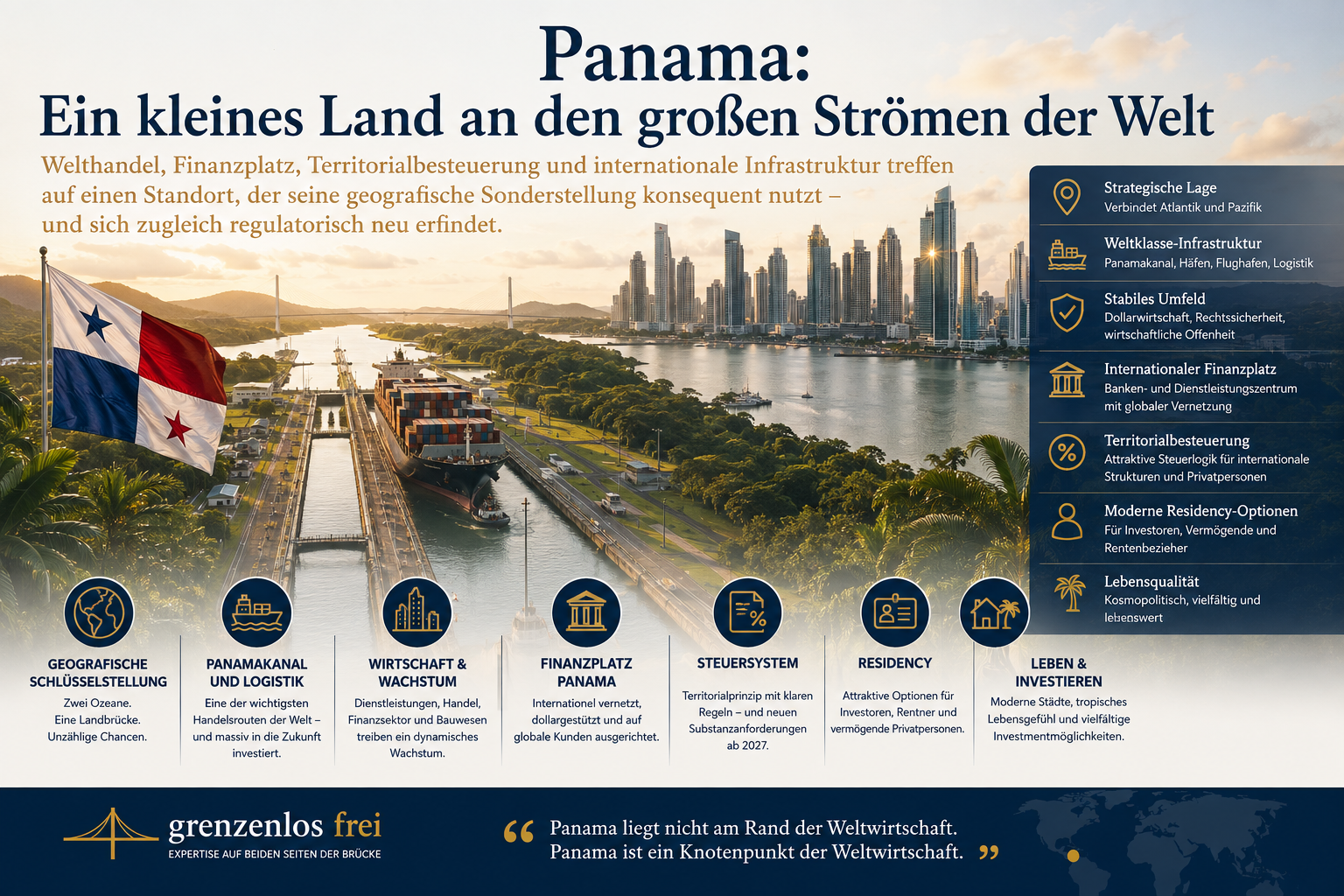
1. A small country at a global pivot point
Panama is a state with a population of just a few million. Measured by area and population, the country is small. Measured by its role in international flows of goods, capital and people, it is not.
The reason is, first of all, geographic. Panama forms the land bridge between North and South America and, at its narrowest point, separates the Atlantic (or Caribbean) from the Pacific. The Panama Canal has made this narrowness economically usable for over a century: it shortens sea routes, connects economic areas, and turns a small state into a fixed component of global supply chains.
But that does not yet answer the real question. The question is not why a canal is economically useful. The question is: why is a country of this size disproportionately relevant to world trade, logistics, banking, international business, investors and mobile individuals – and relevant today, not in 1914?
The answer lies in the combination. Over decades, Panama has built a services, logistics and financial economy out of a geographic exceptionalism whose significance reaches well beyond its own domestic economy. Location is the starting point, not the business model.
„Panama does not benefit from lying off to the side of the world's great flows. Panama earns its living from lying in the middle of them.“
2. Economy – a services location, not a commodities story
Panama's economy is strongly services-oriented. Trade, transport and logistics, financial services, tourism, construction and internationally oriented business services define its character. The canal is only one part of a broader services complex that includes ports, free zones, warehousing, air transport and business-related services.
For 2025, the World Bank reports real economic growth of around 4.4 percent, driven essentially by the services sector. That is a high figure by regional standards – and, at the same time, a figure that does not resolve the country's internal imbalances.
For 2026, as of the information date of this article, only forecasts are available, and they diverge: in its Macro Poverty Outlook, the World Bank expects medium-term growth of around four percent, while the International Monetary Fund projects a lower figure of around 3.8 percent for 2026. Both figures come from official sources and are forecasts, not actual outturns.
One rupture of recent years remains visible: the closure of the Cobre Panamá copper mine at the end of 2023 removed a substantial contribution to exports, investment and government revenue. That the economy nonetheless continued to grow afterwards demonstrates the resilience of the services sector – not that the loss was without consequence. As of the legal position of this article, no final decision has been taken on the mine's future.
3. The Panama Canal – not a monument, but an investment programme
Anyone who views the canal merely as a historic feat of engineering is missing the actual development. With its Visión 2025–2035, the Autoridad del Canal de Panamá (ACP) is pursuing a strategic investment programme of around eight billion balboas over ten years.
The substantive priorities can be summarised in a few points:
- Water security — in particular the Río Indio multi-purpose project, intended to secure water availability for canal operations and drinking-water supply over the long term.
- Port and terminal development — additional container capacity on both ocean sides, for which the ACP published tender documentation in early 2026.
- Multimodal logistics — closer integration of canal, ports, land transport and warehousing along the interoceanic route.
- Interoceanic Energy Corridor — a planned energy corridor between the Atlantic and Pacific sides, whose first major project is a pipeline together with associated terminal infrastructure.
For the energy corridor, the timeline matters. The concept envisages transporting energy sources between the two ocean sides via a land connection, thereby supplementing and relieving existing canal infrastructure. As of the information date of this article, the project is at the tender and pre-qualification stage; a final award decision has not been confirmed.
The same applies to the new port projects: published tender documentation is not a completed terminal. For a location assessment, the distinction between existing infrastructure, approved projects, planned schemes and ongoing tenders is not academic – it is the core of the assessment.
„An investment programme is a signal about priorities. It is not yet a structure.“
4. Water – strategic resource and real risk
The drought of 2023/24 showed how closely Panama's economic reliability depends on water. The canal operates with locks that require substantial volumes of fresh water for every transit. As reservoir levels fell, the canal authority significantly reduced daily transit slots – with immediate effects on waiting times, prices and global route planning.
Water in Panama is therefore not merely an environmental issue. It simultaneously affects the drinking-water supply of a substantial share of the population, canal operations, and hence the reliability of an internationally significant trade route.
Against this background, Río Indio is less a single infrastructure project than a strategic scheme for long-term water security. It is at the same time a project marked by social conflict, in particular over resettlement and compensation in the affected areas.
The subject calls for neither dramatisation nor minimisation. It belongs in every sober assessment of the location – both as a real risk and as an area in which Panama is visibly investing.
5. Logistics and international connections
Panama is a multimodal location. Alongside the interoceanic waterway there are container ports on both the Atlantic and Pacific sides, free-zone and warehousing structures, road links along the canal axis, a rail connection between the two ocean sides, and an international air hub with a dense route network across the Americas.
This combination explains Panama's role as a regional hub: goods, services and people are bundled, transhipped and redistributed here. For internationally active businesses, that matters more than any single metric – accessibility is a location factor in its own right.
Superlatives are of little help here. What matters is whether a given company's actual value creation genuinely benefits from goods flows, transhipment, regional accessibility or proximity to services. Where that is not the case, the logistics location is an interesting fact, but not an operationally meaningful advantage.
6. The dollar economy – examined precisely
Panama's currency system is often described in shorthand that oversimplifies it. The national currency is the balboa, pegged 1:1 to the US dollar. In practice, coins circulate in balboas while the US dollar, as the banknote currency, dominates payment transactions. The claim that "Panama only has the US dollar" is therefore imprecise; what is accurate is that the US dollar plays the central role in payments.
Two things follow economically. For internationally active businesses and investors, the classic exchange-rate risk of an independent local currency against the US dollar disappears; prices, balance sheets and contracts are directly comparable internationally. For the financial and trading centre, dollarisation is a key reason for its pull on regional capital flows.
That does not mean there is no currency risk at all. Anyone thinking in euros bears the full EUR/USD risk. And dollarisation strips the country of monetary-policy tools: Panama has no independent central-bank policy in the classic sense and cannot steer interest-rate policy nationally.
7. International financial centre
Panama maintains an internationally oriented banking system that is remarkably large for a country of this population size. According to the banking report of the Superintendencia de Bancos de Panamá, the international banking centre had net assets of around USD 163.0 billion at the end of 2025, against deposits of around USD 116.8 billion.
The structure is notable: of these deposits, around USD 46.6 billion came from external depositors, i.e. those not resident in Panama. The foreign share is thus around 40 percent – a clear indication that the location does not merely finance its own economy but channels regional and international capital flows.
This scale, however, says nothing about the practicalities of opening an account. Anyone seeking to open accounts in Panama today, whether personally or for a company, will encounter a comprehensive review process: identification and legitimation, establishing beneficial ownership, proof of source of funds, presentation of the business model, review of actual activity, and reporting under CRS and – where relevant – FATCA.
That a business address, a registered agent or an entry in the companies register is not the same as genuine business substance is one of the most common misunderstandings. The distinction between these levels is addressed in the foundational article Registered Office, Management, Permanent Establishment.
In short: the financial centre is capable. It is not condition-free.
8. Panama and the old offshore image
For decades, Panama was internationally closely associated with offshore structures, company formations and confidentiality. This perception still lingers today, particularly since the publication of the so-called Panama Papers.
What matters analytically is less the media coverage than the regulatory development since then. Panama has substantially expanded its transparency, reporting and compliance requirements: automatic information exchange under CRS, registration and reporting duties on beneficial owners, tightened due-diligence requirements in the financial sector and, most recently, substance requirements for certain income.
None of this implies a moral judgment. Foreign structures are not inherently impermissible; what matters is whether they meet the reporting, tax and substance requirements of the states involved. But describing Panama as an anonymous offshore jurisdiction in 2026 is, factually, out of date.
„The modern Panama model is no longer: anonymity without substance.“
9. Territorial taxation – the basic principle
Panama taxes on a territorial basis. In principle, income of Panamanian source is subject to Panamanian tax; income that, under the statutory source rules, does not arise in Panama does not become taxable merely because a person lives in Panama or money is transferred to Panama.
That is a systematic difference from the worldwide-income principle, as applied by Germany, for instance, to persons with unlimited tax liability. And it is the reason Panama regularly features in international structuring discussions.
The basic systematics – worldwide income, the territorial principle, remittance basis and nationality-based taxation – are set out in the foundational article Tax Systems of the World. Anyone who fails to keep these levels cleanly separated will draw almost inevitably wrong conclusions about Panama.
The most important such fallacy concerns the concept of source. "Paid from abroad" is not the same as "foreign source". Tax source is determined by the statutory source rules, not by the location of a bank and not by the customer's place of residence.
A simple example illustrates this. A person lives in Panama, works there physically, and provides consulting services from Panama to a German client. Payment is made from Germany to an account outside Panama. The common conclusion is: tax-free foreign income. That conclusion does not hold up. Whether the income is of Panamanian source depends on Panama's statutory source rules and the specific activity – in particular, on where the service is actually performed.
„Territorial taxation does not mean that the origin of a transfer determines the tax source of the income.“
This does not mean that foreign income is regularly taxable in Panama. What it means is that the qualification is a legal question to be assessed case by case, not a question of which account is used.
10. Income tax for individuals
Before looking at any rate schedule, one clarification is necessary: the following rates apply to income taxable in Panama. They do not mean that the worldwide income of a person living in Panama is subject to this scale. Source is examined first; the rate is applied afterwards.
According to the Dirección General de Ingresos, the rate schedule for individuals is structured as follows:
up to B/.11,000
Taxable income
0%
Taxation
over B/.11,000 up to B/.50,000
Taxable income
15% on the amount exceeding B/.11,000
Taxation
over B/.50,000
Taxable income
B/.5,850 plus 25% on the amount exceeding B/.50,000
Taxation
The legal basis is Article 700 of the Código Fiscal. The schedule also shows that, for income taxable in Panama, Panama is not a low-tax country in the sense of a flat rate – the top rate is 25 percent.
11. Corporate tax
Corporations are subject to a general corporate tax rate of 25 percent on taxable net income. Depending on turnover size, special calculation methods apply to determine the tax base, along with industry-specific rules depending on the activity concerned.
The resulting conclusion is inconvenient but central: Panama is not a zero-tax country. A Panamanian company earning income of Panamanian source is, in principle, subject to regular corporate tax, keeps accounts, files returns and meets ongoing obligations.
Phrases such as "Panama Company = 0% Tax" come from the marketing material of formation providers, not from tax law. They systematically conflate the question of source with the question of tax rate.
12. Dividends
The taxation of dividends in Panama is differentiated and depends on the tax qualification of the underlying profits. The Código Fiscal distinguishes in particular whether the distributed profits derive from income of Panamanian source or from income qualified differently under Panamanian law – for example, from foreign sources or from certain export-related activities.
In practice, a standard rate of 10 percent and a reduced rate of 5 percent for certain scenarios are commonly cited; for certain classes of shares, different, higher rates may apply. What is always decisive is the specific legal basis and the qualification of the distributed profits in the individual case.
A blanket statement that "the dividend tax in Panama is X percent" is therefore not reliable. In addition, special regimes and special zones may carry deviating rules; these are deliberately left outside the scope of this article.
13. ITBMS – the sales tax
Panama's sales tax is called ITBMS (Impuesto de Transferencia de Bienes Muebles y Prestación de Servicios). The standard rate is 7 percent. Different rates or exemptions apply to certain goods and services, and registration and remittance obligations also depend on the activity and turnover size involved. A complete treatment of sales tax law is not the subject of this article.
14. Tax residency
Tax residency must be strictly distinguished from an immigration-law residence permit. Under Article 762-N of the Código Fiscal, an individual is considered tax resident in Panama in particular if they have spent more than 183 days – consecutively or otherwise – in Panama during the tax year or the immediately preceding tax year, or if they maintain a permanent home in Panama meeting the statutory conditions.
Residency can be certified by a Certificado de Residencia Fiscal issued by the tax administration. The certificate is evidence, not a planning tool: it confirms a legal position, it does not create one.
Three equivalences are false, and nonetheless common in practice:
- A residency permit is not the same as tax residence.
- An RUC, or tax number, is not the same as tax residence.
- Tax residence in Panama is not the same as taxation of worldwide income.
The third point is especially central given the territorial principle: even someone who is tax resident in Panama is generally taxable there only on income of Panamanian source. Conversely, that says nothing about how the previous state of residence assesses the matter.
The full distinction between nationality, registered address, domicile, habitual residence, residence permit, tax registration and tax residency is addressed in the foundational article Domicile, Residency, Tax Residence.
15. Double taxation agreements and international tax questions
Panama has concluded double taxation agreements with a number of states. A complete list is of little use here; what matters is the order of examination.
In cross-border situations, the following must always be assessed separately: the domestic source rules of both states involved, tax residency under domestic law, possible dual residency, and – where applicable – the distributive and method articles of an applicable treaty.
How treaties work, what they regulate and what they explicitly do not regulate is set out in the article Double Taxation Agreements.
What territorial taxation explicitly does not do: it does not automatically resolve international tax questions. Whether and how the country of departure continues to assert its tax claim, whether permanent establishments arise, and whether CFC rules apply, is not decided by Panama's tax system.
16. Companies and international structures
Panama has been a well-known company location for decades. The Sociedad Anónima and the Sociedad de Responsabilidad Limitada are internationally familiar, incorporation law is well established, and the administrative infrastructure is well practised.
For a serious assessment, however, other questions are decisive: What activity does the company actually carry out? Where is it managed? Who are the beneficial owners? What substance exists in Panama? And how do the other states involved classify this structure?
The place of incorporation does not automatically determine the place of management, the existence of permanent establishments, the company's tax residency, or the tax treatment of its shareholders. A company incorporated abroad can be tax resident in another state if it is managed there.
These levels and their typical confusion are covered in detail in the article Registered Office, Management, Permanent Establishment. Also relevant, for shareholdings in low-taxed foreign companies, is the question of controlled foreign company (CFC) taxation in the shareholders' state of residence.
For persons with continuing ties to Germany, in particular, the German CFC rules (Hinzurechnungsbesteuerung) must be examined – a question that Panamanian law does not answer.
17. Law 526 of 28 May 2026 – Economic Substance
The most important tax development of 2026 is Law 526 of 28 May 2026, published in Gaceta Oficial No. 30534-B. It amends and supplements the Código Fiscal and inserts a new chapter of substance rules for certain passive foreign-source income.
Scope
The scope is narrower than public perception sometimes suggests. It covers entities that are part of a multinational group – defined as two or more entities connected by ownership or control, tax resident in different jurisdictions, including parent company, subsidiaries and permanent establishments, that are consolidated or would be required to be consolidated.
Companies that are not part of a multinational group within the meaning of the law are, in principle, not caught by this specific substance regime. It is therefore inaccurate to say that all Panama companies with foreign income are affected by the new rules.
Income covered
Covered is certain passive foreign-source income, in particular:
- dividends and profit participations
- interest
- royalties and licence fees
- capital gains
- income from immovable property
- other income from capital assets
Substance requirements
The law requires genuine economic presence in Panama for qualification as an "Entidad calificada". This includes, in particular, qualified and adequately remunerated personnel, suitable premises or facilities, the taking of key decisions and the assumption of the relevant risks in Panama, as well as adequate operating expenditure locally. Simplified requirements apply for pure holding entities and certain real-estate arrangements. Outsourcing to service providers in Panama is possible under statutory conditions; outsourcing abroad does not satisfy the requirements.
Legal consequence
If a covered entity fails to meet the requirements, or breaches the associated reporting and evidentiary obligations, the law provides for a uniform, definitive tax rate of 15 percent on net income for the relevant passive foreign income. Foreign tax paid on the same income may be credited, up to the amount of the Panamanian tax liability. For income from intangible assets, the law contains a separate rule oriented on the nexus approach.
Timing
The timing needs to be kept cleanly separate. The law was passed and published in the Gaceta Oficial on 28 May 2026; it is thus law in force. Under the statutory transitional provisions, the new rules apply from the 2027 tax year. As of the information date of this article, 1 August 2026, key implementing provisions – in particular on evidentiary procedures, registration and reporting formats – have not yet been finally published. Anyone who could be affected should actively monitor the detailed regulations.
What is systematically notable is that Panama is not abandoning the territorial principle. It remains in place. For a clearly delimited area – passive foreign income within multinational groups – it is being supplemented by a substance layer.
„Panama remains territorial – but not every international structure remains without consequence in the absence of substance.“
18. Residency – many routes, three examples
Panama has an unusually large number of immigration-law residence categories by Latin American standards. A complete list would be neither possible nor useful.
The following three categories are therefore expressly an illustrative selection. They are often particularly relevant for entrepreneurs, investors, high-net-worth individuals and retirees. Numerous further residence routes exist besides these, whose requirements depend, among other things, on nationality, employment, investment, income, wealth, family situation and other statutory criteria.
All figures describe the basic structure of the respective category as of the legal position on 1 August 2026. They do not substitute for an immigration-law review, and they contain no statement about processing times or the prospects of success in any individual case.
19. Qualified Investor
The Qualified Investor category is aimed at persons who make a qualifying investment in Panama. The relevant minimum investment is, in principle, B/.300,000.
Various options can qualify as a qualifying investment under the current rules; in practice, the best known is the purchase of real estate in Panama. Here, the statutory minimum amount of B/.300,000 must be raised free of encumbrance. Where the purchase price exceeds that amount, the portion above the required minimum may, under the statutory conditions, be financed.
Under statutory conditions, the investment can also be made through a legal entity, provided the applicant is disclosed and evidenced as the ultimate beneficial owner. Also regularly required is proof of the lawful origin of the funds used, together with the usual personal documentation.
Systematically, the category leads to permanent residence. This says nothing about processing times, administrative practice, or a guarantee of approval. Marketing terms such as "Golden Visa" are not an official designation and do not accurately describe the category.
20. Jubilado / Pensionado
The Pensionado programme is aimed at persons with a qualifying, lifelong pension from a recognised source. It is one of Panama's oldest and internationally best-known residence programmes.
In principle, a monthly pension income of B/.1,000 is required. Where the person holds documented personal ownership of real estate in Panama worth more than B/.100,000, the required minimum monthly pension can, under the statutory conditions, be reduced to B/.750. Additional requirements apply to accompanying dependants.
Various benefits are attached to the status under Panamanian law. A complete list is deliberately not the subject here: this article is a location analysis, not a Pensionado guide.
21. Rentista Retirado
The Rentista Retirado is frequently confused with the Pensionado. It is a distinct category with a fundamentally different logic.
While the Pensionado is based on an existing lifelong pension, the Rentista Retirado is based on a regular return from a prescribed investment structure. What matters is not the capital itself, but the monthly interest income it generates.
A monthly interest income of at least B/.850 is required, from an unencumbered, non-assigned fixed-term deposit at the Banco Nacional de Panamá or the Caja de Ahorros, with a minimum term of five years.
There is, by contrast, no statutorily fixed minimum capital sum. The capital amount actually required depends on the interest rate obtainable at the time. The required capital amount follows arithmetically from the required monthly return and the interest rate on offer: as the interest rate falls, the required capital rises – and vice versa. Figures circulating online as a fixed deposit sum are snapshots of a particular interest-rate level, not a statutory requirement.
22. Further residency routes
Alongside these three categories, further routes exist, including, depending on the applicable legal position, economically based categories, work-related residence, further investor models, special national programmes, where applicable the Países Amigos category, and family-based categories.
A note on Países Amigos is warranted: this category is frequently described online, based on outdated information, as a particularly simple standard route with low bank-balance requirements. The legal requirements have become considerably more differentiated since the reforms of recent years. Older descriptions are unsuitable as a basis for planning.
„Which category fits is an individual immigration-law question – not a ranking of the supposedly easiest visas.“
For orientation, a compact comparison of the three categories presented as examples:
Basic concept
Qualified Investor
Qualifying investment in Panama
Jubilado / Pensionado
Existing lifelong pension
Rentista Retirado
Regular return from a prescribed investment structure
Key requirement
Qualified Investor
Minimum investment, in principle B/.300,000
Jubilado / Pensionado
In principle B/.1,000 monthly, reduced to B/.750 with qualifying real estate ownership
Rentista Retirado
At least B/.850 monthly interest income from a qualifying, unencumbered fixed-term deposit; minimum term five years
Typical target group
Qualified Investor
Investors and entrepreneurs
Jubilado / Pensionado
Retirees with a pension entitlement
Rentista Retirado
Persons with capital but no qualifying pension
Points to note
Qualified Investor
Source of funds, UBO evidence where investing through a company
Jubilado / Pensionado
Property value threshold, proof of the pension's permanence
Rentista Retirado
Required capital depends on the interest rate, no fixed sum
23. Residency is not tax residence
After these examples, it is worth deliberately returning to the tax section. An immigration-law residence permit answers exactly one question: may I lawfully stay and live here?
It does not answer where I am tax resident. And it certainly does not answer which of my income is taxable in Panama. The first question is governed by the criteria for tax residency, the second by the source rules.
Anyone who fails to answer these three levels – residence, residency, source – separately is planning on unstable ground. The foundational article Domicile, Residency, Tax Residence sorts these concepts systematically.
24. Real estate – a brief note
Panama City has a developed apartment and high-rise market with international buyers. Real estate there can serve several functions at once: living, capital investment and, within the Qualified Investor category, an immigration-law function.
Two points matter. First: real estate ownership alone does not establish tax residency. Second: taxes and transaction costs arise on acquisition and holding, the specific structure of which depends on the property, its use and the applicable exemptions.
This article deliberately goes no further. Rental yields, value-appreciation forecasts, neighbourhood assessments and international location comparisons belong to a dedicated analysis of real estate markets – and that is reserved for a separate article.
25. Living in Panama
Panama is not a homogeneous place to live. Panama City is international, urban and rich in services: banks, clinics, international schools, restaurants, a dense flight network. The coastal regions on the Pacific and the Caribbean, the highlands around Boquete and Volcán, and smaller towns inland function quite differently – quieter, less international, with markedly different infrastructure.
Describing the cost of living as low across the board would be misleading. Depending on location, type of housing, choice of school and healthcare provision, Panama can be considerably more expensive than other Latin American locations – particularly in Panama City and particularly at an international standard of living. Imported goods are often expensive; local services comparatively cheap.
Healthcare, international schools and flight connections are heavily concentrated in the capital region. Anyone living outside it gains in tranquillity and cost – and loses in density of infrastructure. That is not a judgment, but a planning factor.
26. Opportunities
Panama's locational advantages can be summarised objectively:
- a strategic geographic position between two oceans and two continents
- internationally relevant logistics, with a canal, ports and an air transport hub
- an ongoing investment programme by the canal over the coming decade
- a financial centre of disproportionate importance for the country's size
- a dollar-based economy without an independent local exchange-rate risk against the USD
- a broad, growing services economy
- international connectivity and regional accessibility
- a fundamentally territorial tax system
- a wide range of immigration-law residence categories
- comparatively developed infrastructure by regional standards
27. Risks and weaknesses
A location analysis that names only opportunities is not an analysis. Panama has structural weaknesses that matter for planning.
- Water — canal operations and drinking-water supply compete for the same resource. The 2023/24 drought showed how quickly climatic fluctuations translate into economic effects.
- Fiscal position — the World Bank and IMF point to a need for consolidation in public finances. Deficit and debt developments are central themes of economic policy.
- Cobre Panamá — the loss of a substantial block of exports and revenue continues to be felt; no final decision has been taken on the mine's future. The uncertainty itself is a factor.
- Social inequality — macroeconomic success is distributed very unevenly across regions and society. The metrics of the capital region do not describe the whole country.
- Bureaucracy — administrative, immigration, tax and banking processes are formalised, documentation-intensive and time-consuming. Anyone underestimating administrative friction is planning too optimistically.
- International compliance — Panama is under significantly greater international transparency and compliance scrutiny than in earlier decades. Structures must be able to withstand this.
28. What Panama is not
A number of widespread assumptions do not withstand scrutiny. In compact form:
- Panama is not a zero-tax country.
- A Panama company is not automatically tax-free.
- "Client abroad" does not automatically mean "foreign source of income".
- "Payment to a foreign account" does not automatically mean tax-free foreign income.
- Residency does not automatically mean tax residence.
- A tax number does not automatically mean tax residence.
- Real estate ownership does not automatically mean tax residence.
- Territorial taxation does not automatically mean tax exemption.
- Forming a company does not answer the question of management or permanent establishment.
29. Panama in international context
The question of whether Panama is "better" than another location is misleading. Locations serve different functions, and a location is only ever suitable or unsuitable in relation to a specific objective.
Panama's specific profile arises from a particular combination: world trade and goods flows, a geographic position between two oceans, a dollar economy, an international financial centre, developed transport infrastructure and a territorial tax system. Anyone who genuinely needs these factors will find a great deal here. Anyone with different priorities – proximity to Europe, a particular treaty network, or a specific industry environment, for instance – may find them better elsewhere.
That is precisely the working method of grenzenlos frei: the starting point is not a country but an objective. The location is the result of the strategy, not its starting point.
Conclusion
Panama's strength lies neither in a single tax advantage, nor in a residency programme, nor in the canal alone. It arises from their interplay: geographic location, infrastructure and logistics, international connectivity, a capable financial system, and a tax system that follows its own logic internationally.
At the same time, the location is becoming more demanding. Transparency requirements, compliance expectations and – since 2026 – substance rules for certain passive foreign income demand more than a certificate of incorporation. This is not a deterioration but a shift: away from formal arrangement, towards genuine presence.
For entrepreneurs, investors and internationally mobile individuals, this means: Panama can still be used sensibly, but it cannot be shortcut. The questions of source, residency, management and substance must be answered before the location decision, not after it.
„Panama does not lie on the edge of the world economy. Panama is a hub of the world economy.“
Sources & further data
- Gaceta Oficial N° 30534-B — Ley 526 of 28 May 2026 — Original law on amendments to the Código Fiscal and substance rules for certain passive foreign-source income
- Dirección General de Ingresos (DGI) — Tarifas del Impuesto sobre la Renta — Official income tax rates for individuals under Article 700 Código Fiscal
- Código Fiscal de la República de Panamá — Statutory text including income tax, corporate tax, source rules and Article 762-N on tax residency
- OECD — Tax Residency Rules: Panama — Compilation of Panama's residency criteria under Article 762-N Código Fiscal
- Autoridad del Canal de Panamá — Visión 2025–2035 — The canal's strategic investment programme for the coming decade
- Autoridad del Canal de Panamá — Corredor Energético Interoceánico — Official project presentation of the planned interoceanic energy corridor
- Autoridad del Canal de Panamá — Proyecto Lago Río Indio — Multi-purpose project for the long-term water security of canal operations and drinking-water supply
- Superintendencia de Bancos de Panamá — Informe de Actividad Bancaria, December 2025 — Official figures for the international banking centre: assets, deposits, internal and external shares
- Ministerio de Economía y Finanzas — Informe de Balance Fiscal, December 2025 — Public finances, revenue, expenditure and deficit developments
- Instituto Nacional de Estadística y Censo (INEC) — Official statistics on population, economic output and sector developments
- World Bank — Macro Poverty Outlook: Panama — 2025 growth data and medium-term forecasts
- International Monetary Fund — Panama Country Page — Projections and country reports, including the Article IV consultation
- Servicio Nacional de Migración de Panamá — Competent authority for all residence categories and their current requirements
- Panamá Digital — Permiso de residente permanente como Rentista Retirado — Official procedural description of the Rentista Retirado category
- MICI — Decreto Ejecutivo 722 de 2020 (Qualified Investor) — Legal basis of the Qualified Investor category, including investment thresholds
More perspectives
Taxes & Structures
Wohnsitz, Residency, Steuerresidenz: Sieben Begriffe, die ständig verwechselt werden
„Ich bin doch Resident.“ „Ich habe dort eine Steuernummer.“ „Ich bin in Deutschland abgemeldet.“ Alle diese Sätze können zutreffen – und beantworten trotzdem völlig unterschiedliche Fragen. Ein Grundlagenartikel über sieben Begriffe, die im internationalen Alltag ständig vermischt werden.
Read articleTaxes & Structures
Registersitz, Geschäftsleitung, Betriebsstätte: Wo sitzt eine Gesellschaft eigentlich?
„Meine Firma sitzt in Wyoming.“ „Die Gesellschaft ist doch in Dubai.“ „Wir haben eine Niederlassung in Paraguay.“ Alle diese Sätze können richtig sein – und beantworten trotzdem völlig unterschiedliche Fragen. Das Schwesterstück zum Grundlagenartikel über die Verortung natürlicher Personen.
Read articleTaxes & Structures
Steuersysteme der Welt: Was jeder Auswanderer verstehen muss
Steuern folgen dem Wohnsitz. Das gilt in Deutschland – aber nicht überall nach denselben Regeln. Wer auswandert, ohne zu verstehen, nach welchem System das Zielland sein Einkommen besteuert, riskiert unangenehme Überraschungen: Steuernachforderungen, Doppelbesteuerung oder ein Setup, das auf dem Papier clever wirkt, in der Praxis aber nicht funktioniert.
Read article