
Economy & Jurisdictions
Asunción – The Underrated Metropolis
Urbanisation in fast-forward: how Paraguay's capital is reinventing itself within a few short years
Klaus J. P.-Kilfitt · 7 September 2026 · 12 min read
Anyone driving through Paraguay's capital Asunción today experiences a city marked by upheaval and change. Grasping just how fundamentally the cityscape is shifting requires no particular vision – it is quite enough, occasionally, to look up.
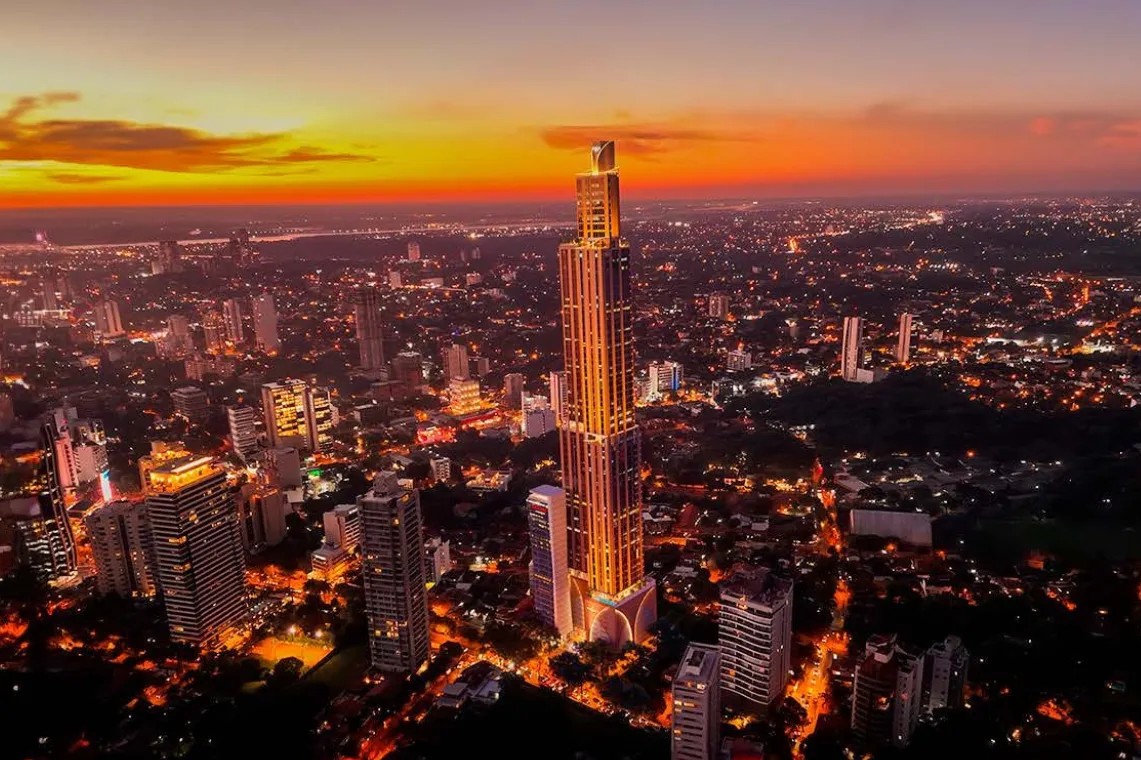
Construction cranes have by now become almost a fixture of the cityscape – as have the potholes, which reliably remind you that between economic development and municipal reality there can still be a certain time lag.
What is new is not so much that building is happening. Asunción has always built. What is new is the speed at which the city is now developing in a direction that was largely alien to it for decades: upward.
By the end of 2025, our research identifies a total of 31 buildings in Asunción belonging to the category we can classify – deliberately without a tape measure in hand – as "historic skyscrapers" (100 metres and above). This also includes individual borderline cases just below that mark, provided they belong to the same urban-planning league and significantly define, or once defined, the cityscape.
The first of these historic giants, the legendary Edificio Aurora, which held the record as Paraguay's tallest building for 15 years, dates from 1978.
Almost as many buildings in this category – namely 27 (as of 1 August 2026) – could be identified by us for the coming five years alone. These are approved projects that meet the aforementioned criteria (100 metres or taller), are already under construction or being marketed, and are due for completion by 2030/31.
In other words, over the coming five years Asunción will produce as many skyscrapers as it did over the preceding half-century.
From Solitaire to Skyline
And yet the story began in decidedly modest fashion.
When the 27-storey Aurora I, standing at almost 96 metres, was completed in the mid-1970s, it was not part of a skyline. It was the skyline. A vertical solitaire in a city whose built environment otherwise ran largely horizontal.
Only in 1993 did the 107-metre, 31-storey Torre Wilson follow. Another exclamation mark, but not yet a trend line. Two skyscrapers within 15 years can hardly be called a trend – particularly at a time when New York City alone was putting up roughly 150 skyscrapers over the same period.
It took a further two decades or so before the picture began to change fundamentally. With the roughly 140-metre Ícono, Asunción gained a new landmark in 2014.
At the same time, the capital's economic centre of gravity increasingly shifted eastward out of the historic centre: first to Villa Morra and Recoleta around the new Shopping Mariscal, later further out to Manora, Ycuá Satí and Carmelitas around Shopping del Sol.
Out of architectural solitaires, a new urban structure slowly but unstoppably emerged – the skyline of a modern metropolis.
Few places demonstrate how quickly such a development can transform a city's face better than the area around Shopping del Sol: only 16 years separate these two photographs.
2009
2025
In 2025, this vertical development reached its provisional peak with the 172-metre Petra Tower.
And the emphasis is firmly on "provisional"!
Because what is currently being planned and built far surpasses everything that has come before:
Paseo 55 is set to reach 212 metres, and the 73-storey Petra Imperiale as much as 250 metres. Alongside these, sculptural ensembles are emerging, such as the Palmanova Center with its four avant-garde towers (Gold Winner at the International Architecture & Design Awards), and the futuristic Sudameris Plaza designed by the legendary British architecture firm Foster + Partners, as well as the Petra Icon Tower, the Link Center, Aether by CIVIS, ACRO Home and a whole series of further megaprojects that, twenty years ago, would not merely have been unusual in Asunción, but simply unthinkable.
And even this list only shows the top hundred metres of a much broader construction boom.
Back in September 2024, the city administration reported more than 288 approved construction projects – explicitly not 288 skyscrapers, but projects of the most varied scale, some of which were already under construction. Even in 2026, the Municipalidad continued to report high levels of building activity, numerous approved or pending projects, and substantially higher revenues from the construction sector.
The development is especially visible along the major corridors of Santa Teresa, Aviadores del Chaco, San Martín and Molas López. At the same time, new development poles are emerging – such as the Distrito Perseverancia, where, on several hectares of former industrial wasteland in the once rather sleepy Barrio Jara, an entirely new city district is practically growing out of the ground, one whose scale, architecture and standard are more reminiscent of Dubai than of a residential neighbourhood in an emerging economy.
The high-rises on our list are therefore not the construction boom itself.
They are its exclamation mark.
Quite Nice for Latin America – But Spectacular?
To judge that, a change of perspective is helpful.
Around 60 buildings in the 100-metre class in a South American metropolis may, at first glance from a European vantage point, sound rather unspectacular. Asunción is, after all, not New York, London or Dubai. Paraguay is still considered an emerging economy, and anyone arriving here for the first time from Germany, Austria or Switzerland probably expects quite a lot – a skyline that can compete with major European cities, but perhaps not quite that.
So let us apply the yardstick.
The same one, in fact, that we used for Asunción. What matters here is not the academic question of whether a building measures 98.57 or 100.01 metres, but the urban-planning 100-metre class. Historic landmarks are included as well. If a church tower has been rising a hundred metres into the sky for centuries, it does not simply vanish from the city silhouette for lack of a rooftop bar.
By this measure, Munich comes to seven buildings. The shortest of them is, of all things, the Frauenkirche at 98.57 metres, which its patron, Duke Sigismund of Bavaria, wanted to rise 100 metres into the Bavarian sky. But the measuring methods of the time were not quite that precise, and good intentions count for something.
Berlin comes to nine buildings in this category.
Hamburg to ten – though on closer inspection that figure develops a charm of its own. A considerable part of this height class there is not made up of glass office towers at all, but of the Nikolaikirche, St Petri, the Michel, St Jacobi, St Katharinen and Hamburg's city hall.
Cologne also comes to ten. At the very top there, to this day, stands not some soulless corporate tower at 157 metres, but Cologne Cathedral.
And the whole of Switzerland?
Six.
Not Zurich; not Basel; not Geneva – Switzerland.
And how does neighbouring Austria fare?
Vienna is, after all, an internationally significant metropolis: almost two million inhabitants, home to numerous international organisations and – alongside New York, Geneva and Nairobi – one of only four United Nations headquarters worldwide. At the Vienna International Centre alone, around 5,000 people from more than 125 countries work. The so-called UNO-City, with office towers up to 120 metres tall, is itself part of the skyline.
Vienna comes to around 26 buildings in our 100-metre class.
Asunción already had 31 by the end of 2025.
That leaves the European wild card, Frankfurt. Not a metropolis of millions, admittedly, but famous for its skyline. Mainhattan.
Wait a Moment: More High-Rises Than Frankfurt?
Commerzbank Tower, Messeturm, Main Tower, Tower 185, Omniturm, FOUR – Frankfurt's skyline has no rival in Germany. Anyone from German-speaking Europe who hears "skyscraper" thinks of Frankfurt.
In our 100-metre class, Frankfurt comes to around 45 buildings.
By around 2030/31, Asunción will stand at roughly 60. At the very least; new projects are being added almost weekly.
No, this does not turn Asunción into Frankfurt. And it does not suddenly turn Frankfurt into a sleepy provincial backwater on the Main either. (Though ill-natured tongues claim it always was exactly that.) Cities can neither be judged by a single metric, nor is economic significance measured in metres.
That is not the point.
The point is perception.
Anyone who smiles faintly at "roughly 60 high-rises in Paraguay", yet thinks of a pulsating European metropolis at the words "Frankfurt skyline", has perhaps just learned less about architecture than about their own assumptions of what a capital in a so-called emerging economy is supposed to look like.
For an upward comparison, a brief glance beyond the German-speaking world will do: Los Angeles comes to nearly 90 buildings of this scale, London to well over 130. And New York City is, and remains, the Big Apple.
The decisive point, in any case, lies elsewhere:
Asunción has not fully arrived in that league yet. But it is heading there in seven-league boots.
The Interesting Number Is Not 58
A city that took decades to produce 31 high-rises of this size class, and is now planning and building a further 27 within just a few years, does not merely change its silhouette. Along with the buildings, land prices, forms of housing, population structure, traffic flows and, ultimately, the geography of the city itself all change.
In Asunción, the next step can already be observed. While the previous waves of development played out mainly in the east of the capital, new urban poles are now emerging in places that hardly anyone would previously have associated with the future centre of the metropolis. The Distrito Perseverancia already mentioned is a good example of this.
Such projects do not merely change individual plots of land or streets. They change the question of where the city of tomorrow actually takes place.
And that is why the most interesting number in this article is not 58.
The truly interesting number is five.
Five years, in which almost as much vertical city could emerge as in the five decades before it.
Those Who Would Have Liked to Be There Then
Naturally, a development of this kind invites comparison with property markets that have already been through this process.
Dubai and Panama City are two obvious examples – not because Asunción is becoming the next Dubai, but because these two internationally closely watched markets have already reached a level of maturity that Paraguay's capital is still a long way from.
Anyone who has ever caught themselves, looking at Dubai or Panama City, wishing they had invested there twenty or thirty years earlier, should therefore at least understand why a young market like Asunción deserves attention right now.
Not because history repeats itself like a script.
Nor because every new building is automatically a good investment.
But because markets often go through their most interesting phases before everyone knows they are interesting.
In an established market, after all, the investor is not just paying for a building. They are also paying for a share of the certainty that the market has by now created. In a young market, part of that certainty is missing – and that is precisely where both its risks and its opportunities lie.
Asunción currently finds itself quite visibly right on that threshold.
A Skyline Needs a City Beneath It
That said, you cannot simply fill a metropolis with high-rises without limit and then hope that the rest will somehow sort itself out.
People need to get to work, children to school, residents home; new residential and office districts generate traffic flows, and anyone who knows Asunción at rush hour will need a certain intellectual effort to maintain that the existing road network has substantial unused capacity in reserve.
It is therefore interesting that, alongside the private construction boom, infrastructure projects responding to the growth of the Asunción metropolitan region are now also becoming concrete.
Perhaps the most symbolically charged of these is, of all things, something the city already once had:
the railway.
And not just any railway.
In the mid-19th century, Paraguay was among the first countries in South America to build a railway. Under Carlos Antonio López, the Ferrocarril arose, which became a symbol of the country's early phase of modernisation. As early as 25 December 1861, the line from Ybyray, today's Trinidad, to Luque was opened; the imposing Estación Central in Asunción followed as one of the significant buildings of that era.
More than 160 years later, this very historic corridor is set to once again become part of Paraguay's modernisation.
The first phase of the new electric Tren de Cercanías is to run from the historic Estación Central in Asunción to Luque – largely along the corridor of, and making use of the land and stations of, the old Ferrocarril Carlos Antonio López. A later extension to Ypacaraí is intended to extend the line to a total of roughly 44 kilometres.
The project is being carried out jointly by the Paraguayan state rail company FEPASA and Etihad Rail, the state railway company of the United Arab Emirates. The first section is budgeted at around US$400 million in total, and under the current schedule, construction work is due to begin as early as April 2027.
What is interesting here is not merely that Asunción is getting a train again. The transport project is explicitly intended to serve as a new development axis for the metropolitan area, to attract investment and to bring order to further urban development.
A railway line that, more than 160 years ago, once meant modernisation is thus intended to enable modernisation once again.
Sometimes history perhaps really does repeat itself after all – or at least rhymes.
Between Crane and Pothole
None of this makes Asunción a perfectly functioning modern metropolis just yet.
Anyone who claims otherwise has probably never actually been here – or was driven straight from the airport to a show flat on Avenida Santa Teresa and then straight back again.
The city has obvious shortcomings. Public transport, roads, pavements, drainage and urban planning do not keep pace everywhere with the speed of private investment. The contrast between a state-of-the-art new building and its immediate surroundings can be considerable.
One should, however, be wary of simply attributing this state of affairs prematurely to the presumed backwardness of an emerging economy.
In April 2024, an extraordinary downpour left even the multi-billion-dollar metropolis of Dubai partly under water. Motorways flooded, airport operations were massively disrupted, residential complexes and car parks filled up; the insured damage later estimated overall ran to several billion dollars.
Even a great deal of money does not fully suspend the laws of nature, and infrastructure often grows more slowly than the city it is meant to support, even in places where money is supposedly no object.
The difference lies rather in the fact that Asunción still displays its contradictions largely unconcealed. Skyscrapers and potholes, luxury apartments and sagging power lines, award-winning architecture and a pavement that abruptly ends in the middle of nowhere.
You can view that as a shortcoming. It is one, too.
But at the same time it says something about the phase the city is in.
A mature city presents the visitor, for the most part, with the finished result of its development.
In Asunción, you can still watch the process itself.
You see scrapyards that will be built on tomorrow; entire neighbourhoods whose function and significance are shifting; new centres that hardly anyone would have described as such just a few years ago; a 19th-century railway line that has suddenly become part of future planning once again.
And a skyline whose tallest buildings, in part, do not yet even exist.
At the end of 2025, we counted around 30 skyscrapers. By 2030, that figure will have roughly doubled.
Whether every single one of these megaprojects will actually be completed on time, we do not know. "Tranquilo" holds central importance in this country; project developments get delayed, markets change – and at the same time, new, sometimes spectacular projects are unveiled in Asunción almost weekly.
The 27 aspirants to the future skyline are therefore less a forecast of everything that will have been built by 2030/31 overall, than a snapshot of what we already know of it today.
Asunción took almost half a century to build its current skyline.
Now the city is beginning to do the same thing all over again. In just five years.
More perspectives
Taxes & Structures
Paraguay: Territorial Taxation Doesn't Automatically Mean 0% Tax
Residencia, cédula, RUC, foreign clients – and supposedly no tax. Paraguayan tax law doesn't work that simply. Why the territorial principle is really a question of source, and why that is precisely what makes Paraguay a genuinely interesting location.
Read articleEconomy & Jurisdictions
Paraguay Discovered
Migration, tourism, investment, energy and infrastructure are developing at the same time. Why Paraguay is being rediscovered as a business location in 2026.
Read articleTaxes & Structures
Steuersysteme der Welt: Was jeder Auswanderer verstehen muss
Steuern folgen dem Wohnsitz. Das gilt in Deutschland – aber nicht überall nach denselben Regeln. Wer auswandert, ohne zu verstehen, nach welchem System das Zielland sein Einkommen besteuert, riskiert unangenehme Überraschungen: Steuernachforderungen, Doppelbesteuerung oder ein Setup, das auf dem Papier clever wirkt, in der Praxis aber nicht funktioniert.
Read article